
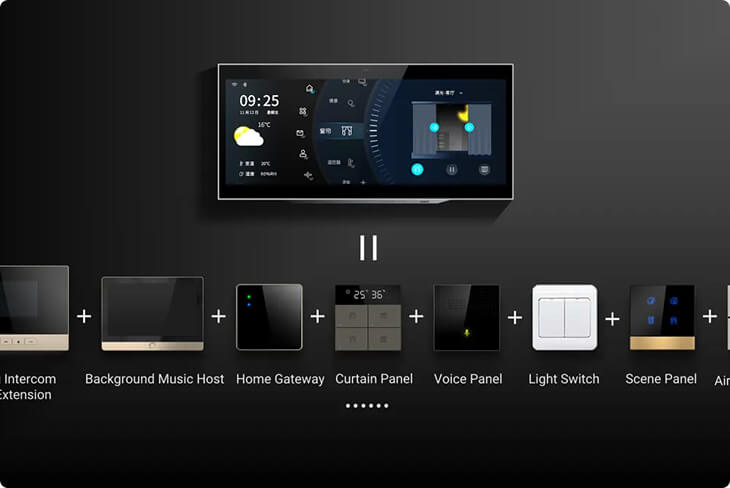
With the continuous advancement of building intelligence and the increasing integration of home automation systems, switch panels have gradually evolved from traditional “mechanical switches” into comprehensive interface components that integrate control, display, interaction, and decorative functions. Under this trend, the choice of panel material directly affects product reliability, visual quality, and overall user experience.
Glass, as a mature and highly customizable functional material, has become a mainstream choice for mid- to high-end switch panel design due to its stable physical and chemical properties, excellent optical performance, and strong design flexibility. Whether in smart home systems, commercial building control panels, or high-end residential applications, glass panels demonstrate clear technical and visual advantages.
This article starts from the intrinsic performance advantages of glass materials and, combined with the comprehensive requirements of modern switch panels in terms of functionality, aesthetics, safety, and durability, further introduces key application technologies such as glass processing, printing, surface treatment, and strengthening. It systematically analyzes the practical feasibility and long-term reliability of glass switch panels in real-world projects.
Glass materials feature high surface hardness and excellent wear resistance, making them resistant to scratches from fingernails, keys, or other common hard objects during daily use. The Mohs hardness of glass typically reaches above level 6, allowing it to withstand most common abrasion scenarios. After physical tempering or chemical strengthening, the impact resistance of glass panels can be significantly improved.
In addition, glass offers excellent dimensional stability and is not prone to deformation under temperature fluctuations or long-term use—an especially important characteristic for the assembly precision of switch panels. With a low thermal expansion coefficient, glass can maintain stable shape and dimensions within a temperature range of approximately –30°C to 120°C, reducing the risk of deformation or structural failure caused by thermal stress. This property enables glass panels to adapt to various environmental conditions while maintaining stable alignment with frames and internal electronic components, thereby extending the overall product lifespan.
Moreover, the superior optical transparency and surface flatness of glass help achieve clear display performance and responsive touch interaction, making it suitable for high-end appliances, smart terminals, and industrial control panels.
As an inorganic non-metallic material, glass naturally exhibits excellent chemical stability and strong resistance to various environmental media.
In daily use, switch panels are frequently wiped and cleaned. The dense and stable surface structure of glass is resistant to active ingredients in cleaning agents and does not easily yellow, discolor, or suffer coating delamination after prolonged exposure to oils or chemical residues. This ensures long-term consistency in panel appearance and display clarity. As a result, glass panels maintain stable performance in environments with higher humidity and frequent cleaning requirements, such as kitchens, bathrooms, corridors, and public areas.
Compared with certain engineering plastics or composite materials, glass is far less likely to become sticky, soften, crack, or age over long service periods. Its inherent material stability allows products to retain a premium tactile feel and visual appearance even after years of use, reducing maintenance or replacement costs. This long-term reliability is particularly important for mid- to high-end switch panel products that emphasize quality and service life.
Glass naturally offers high light transmittance. Standard ultra-clear soda-lime glass typically achieves a transmittance of over 88%, while aluminosilicate glass can reach above 91%. The optical properties of glass can be precisely adjusted through material selection, thickness control, and surface treatments. Functional coatings such as AR (anti-reflective), AF (anti-fingerprint), and AG (anti-glare) can further enhance optical performance and visual comfort, ensuring clear visibility even under strong ambient lighting. This makes glass highly compatible with backlight modules, LED indicators, and capacitive touch sensing systems used in switch panels.
From an aesthetic perspective, the smooth and flat surface of glass delivers a refined texture that supports modern, minimalist, technological, or luxury design styles. Through well-designed silk-screen printing or UV printing processes, glass surfaces can display clear icons, markings, and functional zones. These printed or engraved patterns appear subtle and clean when unlit, while presenting bright, uniform, and high-contrast visuals when backlit—greatly enhancing the user interaction experience.
In addition, glass offers excellent machinability, enabling complex shapes, chamfered edges, stepped edges, and other structural designs that add depth and dimensionality through light refraction and visual layering. This flexibility provides designers with greater creative freedom to meet customized, high-end, and personalized market demands, significantly increasing product added value and user appeal.
Overall, the application of glass in switch panels achieves a balance between functionality and decoration, transforming the panel from a simple control component into an integral part of the interior design. It is well suited not only for smart home systems but also for high-end residential, commercial office, and hotel environments where visual quality is highly valued.
With the widespread adoption of smart homes, commercial building automation, and multifunctional control systems, switch panels have evolved from simple control components into comprehensive interfaces combining functional interaction, information display, and spatial aesthetics. This evolution places higher technical and quality demands on material selection, structural design, and manufacturing processes.
Modern switch panels often integrate multiple functions such as switching control, status indication, touch sensing, and backlight display. This increased functional complexity and system integration require panel materials to meet higher performance standards, particularly in optical behavior, dimensional precision, and electronic compatibility.
First, glass panels must provide stable and controllable light transmittance to ensure clear visibility of LED indicators, backlit icons, or display areas. In multi-zone backlight designs, glass must achieve precise optical partitioning through printing or coating to prevent light leakage, hotspots, or uneven brightness, ensuring accurate and consistent information display.
Second, in terms of dimensional accuracy and structural compatibility, glass panels must fit precisely with internal touch modules, circuit boards, and mounting frames. Even minor deviations or warpage may affect assembly accuracy, potentially leading to touch inaccuracies, unstable operation, or structural loosening over time. Therefore, high-precision processing and strict dimensional control are essential foundations for functional reliability.
Additionally, glass panels often require through-holes, windows, or special structural features to accommodate different switch modules, sensors, or installation methods. These structures demand high processing accuracy and smooth edges while maintaining overall mechanical strength, ensuring long-term stability and safety.
For touch applications, glass thickness, dielectric properties, and surface treatments directly influence touch sensitivity and response speed. As a result, glass selection and process planning must be closely coordinated with electronic system design to achieve consistent and reliable performance.
As a high-frequency user interface component, switch panels play a critical role in both visual design and user interaction. The smooth and refined surface of glass provides a strong foundation for premium product aesthetics.
Visually, glass can be decorated using silk-screen printing, UV printing, or laser processing to create diverse icons, text, and decorative patterns. When combined with backlighting, the design achieves a “clean and unified appearance when off, and clear readability when on,” enhancing the product’s technological and premium feel—especially common in smart home and high-end commercial environments.
From a user experience perspective, glass offers a smooth tactile feel. When combined with AF anti-fingerprint or anti-smudge coatings, fingerprint marks and oil residues are significantly reduced, allowing the panel to maintain a clean appearance over long-term use. The enhanced surface smoothness also improves touch responsiveness, reinforcing the user’s perception of product quality and reliability.
Furthermore, the high degree of customization in color, light transmittance, and surface effects allows glass panels to seamlessly match different interior design styles—from minimalistic to modern or bespoke luxury spaces.
Safety and durability are core considerations in switch panel material selection. As wall-mounted or publicly accessible components, switch panels experience frequent contact and must maintain structural integrity and safe performance over long service periods.
Tempered glass shatters into small granular fragments when broken, significantly reducing the risk of injury and meeting safety requirements for residential, commercial, and public applications. Strengthened glass also provides higher impact and bending resistance, enabling it to withstand daily pressing, incidental impacts, and environmental stress variations.
In terms of durability, glass exhibits excellent resistance to environmental factors and is minimally affected by temperature changes, humidity, or cleaning frequency. Its surface does not easily age, discolor, or degrade, allowing the panel to maintain consistent appearance and functionality even after years of use. This long-term reliability is particularly valuable for high-quality switch panel products designed for extended service life.
To meet different requirements related to installation, structural safety, and visual design, switch panel glass typically undergoes various precision processing steps. Among these, edge processing is one of the most fundamental and critical processes, directly affecting product safety, assembly stability, and overall tactile quality.
Common edge treatments for switch panel glass include straight edges, chamfered edges, rounded edges, C-edges, and various custom profiles. Straight and chamfered edges are often used in designs with limited installation space, ensuring tight integration with frames or walls. Rounded and C-edges enhance safety and tactile comfort by reducing the risk of cuts or impacts during frequent operation.
With the diversification of design trends, complex edge profiles and irregular shapes are increasingly used in high-end and customized switch panels. These designs require precise planning based on aesthetic intent and internal structural layout, placing higher demands on equipment capability and process control. High-precision CNC machining enables stable production of complex contours, curved edges, and localized structures while maintaining consistent appearance and dimensional accuracy in mass production.
Throughout processing, strict control of edge smoothness and surface quality is essential to prevent micro-cracks or stress concentration, improving tempering success rates and overall product reliability. The combination of precision machining and multi-stage inspection ensures dimensional consistency while providing a strong foundation for long-term structural stability and safety.
Printing is a key process that enables functional zoning, icon display, and overall visual design on switch panel glass. The choice of printing method directly impacts appearance quality, durability, and production consistency. Silk-screen printing and UV digital printing are the most commonly used techniques, each suited to different design and production requirements.
Silk-screen printing is widely used due to its strong adhesion, excellent wear resistance, and weather durability, making it ideal for medium to large batch production. High-precision screens ensure ink firmly bonds to the glass surface, maintaining stable appearance even under repeated cleaning and long-term use. This process is particularly suitable for opaque masking areas, icon printing, and functional zoning, and works effectively with backlight modules for clear and reliable display performance.
UV digital printing excels in small-batch production, multi-variant designs, and customized applications. Without the need for screen preparation, complex graphics, gradients, and layered color effects can be printed directly onto glass, offering greater design flexibility. UV printing is especially suitable for prototyping, new product development, and high-end customization, significantly reducing development time and upfront costs.
In practical applications, these two printing methods can also be combined—for example, using silk-screen printing for primary masking and functional icons, while applying UV printing for decorative elements or special visual effects—achieving both durability and enhanced design expression.
Regardless of the chosen method, careful planning of print positioning accuracy, ink thickness, and compatibility with subsequent tempering or surface treatments is essential to ensure the final product meets expectations in appearance, function, and long-term reliability.
AF (Anti-Fingerprint) coating is a functional surface treatment applied to glass to reduce surface energy, thereby minimizing the adhesion of fingerprints, oils, and water stains. This treatment significantly improves surface cleanliness during frequent daily use.
In switch panel applications, especially touch-based or smart switches, frequent contact leads to fingerprint accumulation that affects appearance and display clarity. AF coatings effectively reduce these residues and make contaminants easier to wipe off, lowering maintenance frequency.
Beyond cleanliness, AF coatings also enhance surface smoothness and tactile comfort, improving touch sensitivity and user interaction—particularly important for capacitive touch panels. Over long-term use, this consistent tactile performance reinforces the perception of product quality.
In high-end smart switch panels where appearance and user experience are critical, AF coatings have increasingly become a standard feature. When properly integrated with printing and tempering processes, AF coatings significantly enhance functionality, durability, and overall product value.
Glass panels used in switch applications typically require enhanced mechanical strength and safety, making strengthening treatments an essential process. Physical tempering and chemical strengthening create stable internal stress structures that significantly improve impact resistance and bending strength, making glass suitable for high-frequency use and long-term service.
Physical tempering involves heating glass to high temperatures followed by rapid cooling, forming a compressive stress layer on the surface. This layer counteracts external forces and improves resistance to breakage. When broken, tempered glass shatters into small granular fragments, reducing injury risk and meeting safety requirements for residential, commercial, and public spaces.
Chemical strengthening uses ion-exchange processes at lower temperatures to enhance surface strength, making it particularly suitable for thin glass or designs requiring high dimensional stability. This method improves durability while preserving flatness and precision, offering a flexible solution for slim or high-precision switch panels.
In practice, the choice of strengthening method depends on glass thickness, structural design, application environment, and safety standards. Proper selection ensures long-term safety, reliability, and stable appearance, providing strong structural assurance for switch panel products.
In switch panel glass applications, material performance is only the foundation. What truly determines scalability, stability, and consistency is processing capability, process integration, and a deep understanding of application scenarios. KS has long focused on functional glass and customized glass panel processing, accumulating extensive experience in switch panel projects and providing systematic solutions from design support to mass production.
KS offers comprehensive glass processing capabilities covering a wide range of thicknesses, sizes, and structural configurations. From standard rectangular panels to customized designs with through-holes, window areas, stepped edges, or complex shapes, our high-precision CNC machining ensures consistent production that meets the strict assembly accuracy and appearance requirements of mid- to high-end products.
In terms of process integration, KS systematically plans edge processing, printing, surface coatings, and strengthening treatments to ensure compatibility and stability across all stages. For example, we ensure strong adhesion and durability of silk-screen or UV printing before tempering or AF coating, achieving a balanced combination of appearance, tactile quality, and safety while minimizing quality risks caused by process conflicts.
KS also emphasizes application-oriented engineering support. At the early project stage, we assist customers in evaluating glass thickness, processing methods, and surface treatments based on product structure, functional requirements, and usage environment. This proactive collaboration helps identify potential risks early, improve mass production efficiency, and shorten overall project timelines.
In quality control, KS has established strict inspection and management systems, monitoring dimensional accuracy, visual quality, and key process parameters throughout production. This ensures high consistency in performance and appearance across every batch, allowing glass switch panels to deliver reliable functionality and excellent user experience over long-term use.
Ready to take your glass project to the next level? Contact us today to discuss your custom glass needs and get a quote!
contact us