Introduction
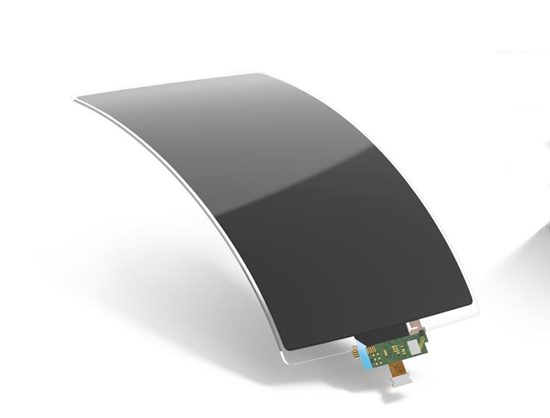
Across consumer electronics, industrial control panels, medical instruments, automotive displays, and smart home appliances, curved glass has evolved from a purely decorative cover into a functional structural component. As industrial designs shift toward seamless enclosures, ergonomic contours, and integrated human-machine interfaces, engineers and B2B procurement teams need more than a glass panel that simply matches a 3D CAD profile. In real operating environments, curved components must maintain tight dimensional tolerances while withstanding mechanical impact, thermal shock, and strict safety fragmentation requirements—making Curve Tempered Glass essential for demanding applications.
Producing curved glass that combines accurate geometry with reliable tempering stress is far more complex than bending a flat sheet and blowing cold air over it. Hot bending and thermal tempering interact across narrow temperature windows, shifting stress fields, and asymmetric cooling geometries. This guide walks through the core manufacturing workflow, compares the primary tempering and strengthening routes used in production, examines the engineering challenges that govern yield and optical quality, and outlines what to evaluate when selecting a manufacturing partner. To explore our broader capabilities in bent glass components, you can also review KS Glass’s Custom Curved Glass solutions.
What Is Curve Tempered Glass?
Definition and Basic Characteristics
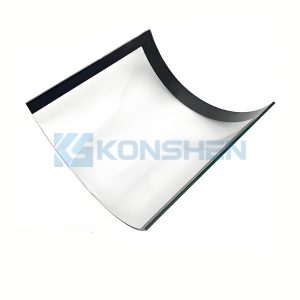
Curve Tempered Glass (also commonly searched as curved tempered glass or bent tempered glass) is a type of tempered safety glass formed by heating pre-processed flat glass to its softening range, shaping it into a target curve, and rapidly cooling its outer surfaces under controlled airflow. This rapid quenching locks high compressive stress into the outer surfaces while placing the inner core in balancing tensile stress, all while preserving the intended curved geometry.
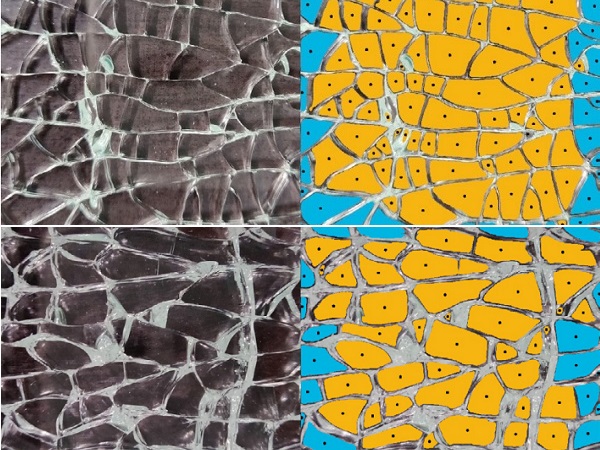
Because the outer surfaces sit under permanent compression, any external impact or bending load must first overcome that compressive barrier before tensile stress can open surface micro-cracks. As a result, properly tempered curved glass resists significantly higher mechanical loads and sudden temperature swings than annealed curved glass of the same thickness. When an extreme impact does exceed its strength limit, the stored elastic energy releases throughout the sheet, breaking the glass into small, relatively dull granular fragments rather than large, sharp shards.
Difference Between Curved Glass and Curve Tempered Glass
One of the most frequent misunderstandings in B2B sourcing occurs when buyers treat “hot-bent glass” and “curved tempered glass” as interchangeable terms. In reality, hot bending is purely a shaping step—it does not temper the glass. Whether a bent panel becomes annealed, heat-strengthened, or fully tempered depends entirely on how it is cooled after forming.
Annealed Curved Glass undergoes slow, controlled cooling inside an annealing lehr or insulated zone after hot bending. Gradual cooling allows internal thermal stresses generated during forming to relax almost completely. Because it experiences no aggressive quenching, annealed curved glass accommodates deep bends, tight radii, and complex double-curved geometries with minimal optical distortion. However, its mechanical strength remains similar to standard float glass, and it shatters into large, sharp pieces. It is typically chosen for low-stress decorative covers, enclosed instrument windows, or parts requiring secondary post-bend machining.
Heat-Strengthened Curved Glass is cooled at a moderate airflow rate after forming. This builds partial surface compression, delivering noticeably better mechanical and thermal shock resistance than annealed glass while keeping surface distortion and roller wave easier to manage than full tempering. Upon breakage, fragments tend to be larger and often remain held within a frame. Still, heat-strengthened glass does not meet full safety-glazing fragmentation standards.
Fully Tempered Curved Glass requires immediate, intense, and uniform high-pressure air quenching as soon as forming is complete and while the glass remains above its critical transition temperature. The outer skin solidifies and contracts first while the core stays viscous; as the core subsequently cools and contracts, it pulls inward against the rigid outer layers, locking in maximum surface compression. This yields the highest impact resistance and thermal durability, but leaves zero margin for post-tempering cutting or drilling and places strict demands on edge finish and cooling symmetry.
Common Applications of Curve Tempered Glass
Not every curved glass component requires full thermal tempering. Selecting the right strength grade depends on assembly constraints, load conditions, and safety regulations.
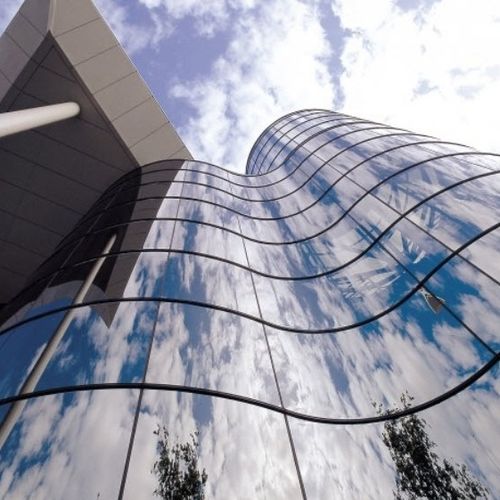
In automotive engineering and vehicle displays, curved center-console cover panels, instrument cluster lenses, and certain side windows rely on curved tempered or heat-strengthened glass (with ultra-thin interior display covers frequently using chemical strengthening instead). These parts must follow sleek cockpit contours while enduring road vibration, wide cabin temperature swings, and crash-safety rules. In industrial equipment and outdoor terminals—such as heavy machinery control shields, outdoor kiosks, EV charger displays, and commercial refrigeration doors—Curve Tempered Glass protects sensitive electronics against accidental impact, frequent cleaning, and weather exposure.
Conversely, for indoor lighting diffusers, static architectural partitions, or protected internal optical windows with deep or irregular curvatures, specifying full thermal tempering can drive up tooling costs and optical distortion unnecessarily. In those scenarios, precision-edged annealed curved glass—or chemically strengthened thin glass for compact electronics—often provides a more practical engineering balance.
How Is Curve Tempered Glass Manufactured?
The curved tempered glass manufacturing process operates as a tightly coupled thermal-mechanical sequence. Unlike flat tempering, every cold-fabrication step must be finalized before the glass enters the furnace, and forming must transition into quenching within seconds.
Glass Cutting and Edge Preparation
Production begins with raw material selection—typically soda-lime glass, ultra-clear (low-iron) glass, or specialized aluminosilicate substrates—matched to optical transmission, thickness tolerance, and budget targets. Flat blanks are then cut via CNC scoring, waterjet, or laser cutting. Crucially, the flat blank dimensions are not a simple 2D projection of the curved drawing; engineers must calculate arc-length development based on bend radius, glass thickness, and neutral-axis shift.
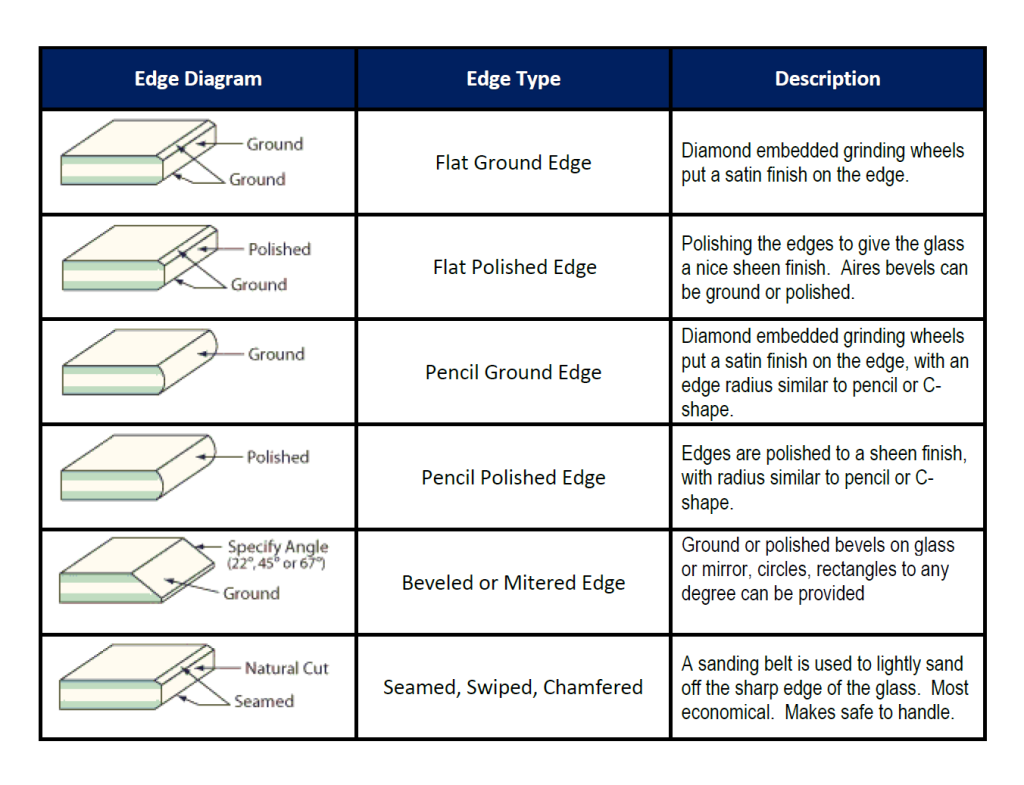
Before any thermal processing begins, all cutting, hole drilling, notch milling, and edge grinding or polishing must be 100% complete. Once thermal tempering establishes a locked internal stress equilibrium, any subsequent mechanical cutting or drilling will shatter the entire panel instantly. Edge quality is equally decisive for yield: during rapid heating and air quenching, glass edges experience steep thermal gradients. Any leftover micro-cracks, chipping, or coarse grinding marks act as stress concentrators that frequently trigger breakage inside the furnace or during the quench blast.
Heating and Softening
Cleaned and dried blanks enter the heating chamber. Because glass is an amorphous solid without a sharp melting point, it transitions gradually above its glass transition temperature into a viscoelastic state. The heating zone must bring the sheet uniformly to its forming and tempering window—soft enough to conform smoothly to the target curve without sagging uncontrollably, sticking to tooling, or developing surface ripples.
Thermal uniformity across both the surface area and the cross-section is critical here. Thicker glass requires longer soak times so the core catches up with the surface; otherwise, viscosity differences between outer and inner layers cause springback or cracking during bending. Ultra-thin glass presents the opposite risk, reacting immediately to minor radiant heat imbalances in the furnace. Different glass compositions also absorb infrared heat differently (ultra-clear glass transmits more radiant heat than standard green-tinted soda-lime glass), requiring tailored heating profiles—especially when high-temperature ceramic inks are pre-printed on the surface.
Curve Glass Forming
Once the glass reaches target softening viscosity, it moves immediately into forming before heat dissipates. Depending on the production line, the softened sheet is shaped by gravity sagging onto a mold, progressive deflection over curved rollers, or mechanical pressing between matched dies.
Regardless of the mechanism, the goal is smooth, continuous deformation without creases, localized thinning, or surface scuffing. At the moment of contact, the thermal conductivity, surface finish, and pressure of the mold or rollers directly affect the glass surface quality. For a closer look at how glass behaves during basic thermal shaping prior to quenching, see our dedicated guide on the Curved Glass Forming Process.
Rapid Cooling and Tempering
Immediately after forming—while the glass remains safely above its strain point—it enters the curved quench section. Arrays of upper and lower contoured air nozzles blast high-pressure ambient air onto both faces of the curved sheet.
The physics of tempering relies on timing the solidification gap between skin and core. High-velocity air cools the outer surfaces rapidly, freezing them into a rigid state while the interior remains hot enough to flow slightly. Moments later, as the core cools and contracts, the already rigid outer skin resists that shrinkage, pulling the core into tension and compressing the outer surfaces tightly.
On a curved geometry, however, achieving uniform heat extraction is substantially harder than on a flat sheet. Airflow strikes the concave (inner) face and convex (outer) face differently: inside a concave arc, air jets can stall or form turbulent eddies at the bottom of the arc, slowing heat transfer; along a convex face, airflow accelerates and escapes toward the edges. If nozzle angles, stand-off distances, and zone pressures are not precisely contoured to the glass radius, uneven cooling creates uneven surface stress and asymmetric thermal shrinkage—pulling the finished curve out of tolerance or causing quench breakage.
Inspection and Quality Control
Completed curved tempered glass must pass multi-dimensional inspection before shipment. Relying solely on destructive fragmentation tests is insufficient for precision B2B components; a complete quality protocol covers six core checks:
1. Dimensional and Profile Accuracy: Verifying chord length, arc length, hole-position shift, and edge contour against CAD tolerances using CMMs, dedicated go/no-go checking fixtures, or optical profilers.
2. Curvature and Bending Depth: Measuring bend radius (R-values), sagitta (bow height), and curve continuity with radius gauges, profile templates, or laser scanners to confirm clean housing fitment.
3. Surface Quality: Inspecting under controlled lighting for scratches, pits, mold marks, haze from release agents, and silk-screen ink adhesion or pinholes.
4. Optical Distortion: Evaluating transmitted and reflected image clarity using zebra-board projection or optical distortion analyzers to catch waviness or localized lensing.
5. Stress and Tempering Verification: Beyond batch-sampled fragmentation testing to confirm safe break patterns, daily production relies on non-destructive surface stress meters (FSM) and polariscopes across multiple points on the curve, paired with ball-drop impact tests where required.
6. Edge Integrity: Re-inspecting chamfers and polished edges for micro-chips or thermally induced edge flaws that could cause delayed failure during assembly.
Main Tempering Methods for Curve Glass
Different furnace architectures combine bending and quenching in distinct ways. Understanding these production routes helps buyers match their part geometry to the right equipment—and complements our overview of standard [Physical Tempered Glass — URL Pending Verification].
Gravity Bending and Quenching
In gravity bending and quenching, a flat glass blank rests on a heat-resistant ring or perimeter mold and travels through the heating furnace together with the tooling. As the glass softens, its own weight pulls it downward until it conforms to the mold profile.
A critical distinction must be made here between two cooling paths: if the glass cools slowly inside the mold through an annealing zone, the result is annealed curved glass—ideal for deep, complex, or double-curved shapes, but without tempering strength. Only when the formed glass is rapidly transferred out of the heating zone into a matching curved air quench does it become curved tempered or heat-strengthened glass.
Gravity bending with quenching keeps tooling relatively adaptable and avoids pressing the central viewing area against a solid upper die, preserving surface smoothness on asymmetric arcs or parts with straight-edge transitions. Its trade-offs are slower cycle times (due to mold thermal mass) and cooling interference: the perimeter mold can partially shield the glass edges from quench airflow, making uniform stress distribution harder to maintain at high volume.
Roller Bending and Tempering
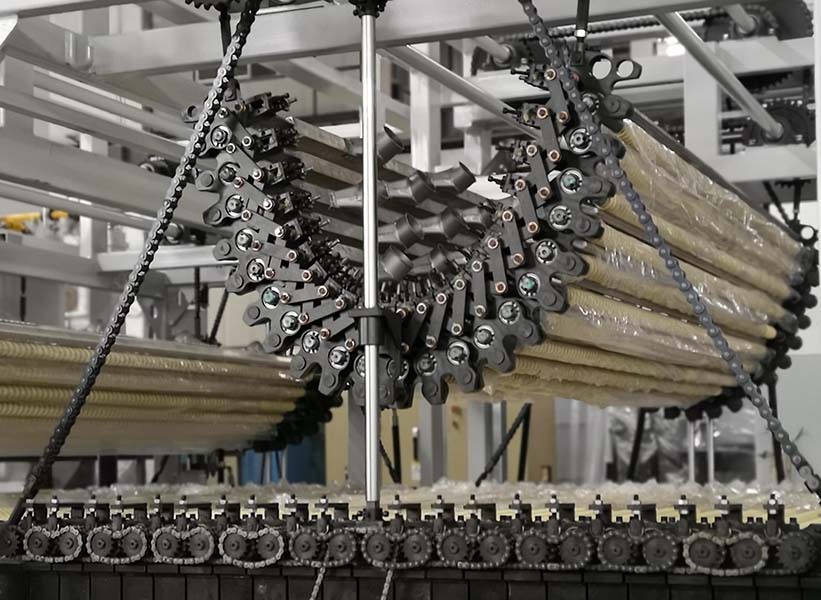
Roller bending and tempering is a widely used automated route for high-volume single-curved glass. Flat blanks oscillate horizontally on ceramic rollers inside the heating furnace until uniformly softened, then transfer rapidly into a bending-and-quenching section. There, a bank of rollers articulates smoothly via servo drives into a curved arc matching the target radius, bending the glass as it moves while contoured upper and lower air nozzles simultaneously quench it.
Because this method requires no product-specific hard molds, changeover is fast, throughput is high, and unit costs remain competitive for medium-to-large cylindrical panels such as display cabinets, architectural curves, and standard-radius industrial shields.
However, roller bending furnaces cannot produce every curvature. Roller pitch sets a physical lower limit on bend radius—if the radius is too tight, the glass bridges across adjacent rollers like a polygon or jams. Standard roller systems are also limited to single-directional cylindrical curves aligned with furnace travel; they cannot form compound double-curved shapes and struggle with small electronic cover lenses that cannot span enough rollers stably.
Press Bending and Tempering
Press bending and tempering serves high-precision applications—such as automotive glazing, tight-tolerance industrial view ports, and contoured instrument covers—where gravity or rollers cannot hold the required geometry. After heating, the softened sheet moves into a press station where precision-machined upper and lower dies (or a full-surface upper mold paired with a lower ring) close rapidly under controlled pressure to stamp the exact 3D profile. Immediately afterward, the glass transfers into a contoured quench.
Press bending delivers superior geometric repeatability, enabling tighter radii, crisp transitions, and controlled shallow double-curved shapes that resist gravity sagging. The downside is substantial tooling investment and setup sensitivity. Each part requires custom heat-resistant dies engineered with thermal-expansion compensation and covered with high-temperature protective cloth or coatings. Excessive press force, premature contact, or worn mold surfaces can imprint orange-peel texture or surface distortion onto the soft glass, while even a brief delay transferring from press to quench can drop glass temperature below the effective tempering threshold.
Chemical Strengthening: An Alternative for Thin and Complex Curved Glass
While Curve Tempered Glass in strict manufacturing terms refers to thermally quenched glass, thin electronic covers, tight radii, and deep 3D geometries frequently hit the physical limits of air quenching. In those cases, engineers turn to a separate route: hot bending + annealing + chemical strengthening. Importantly, chemical strengthening is not a type of thermal tempering—it relies on a completely different post-bend mechanism.
After the glass is hot-bent and slowly annealed to lock in its exact shape without residual thermal distortion, it is immersed in a heated molten potassium salt bath. Through ion exchange, larger potassium ions from the bath replace smaller sodium ions near the glass surface. Upon cooling, those larger ions wedge tightly into the surface structure, creating high compressive stress. Because the process runs well below the glass softening point and requires no high-pressure air blast, it introduces virtually no shape springback, roller wave, or quench breakage.
For ultra-thin curved display covers and complex 3D housings where air quenching fails, chemical strengthening offers higher yield and superior optical clarity. Its trade-offs include a shallower compressive layer depth (making it more sensitive to deep scratches), longer batch immersion cycles, and higher unit cost compared with high-volume thermal tempering.
How to Select the Right Tempering Method
No single curved glass bending or strengthening method fits every project. Selecting the right process requires balancing 3D geometry, glass thickness, optical tolerances, annual volume, and equipment capability.
| Evaluation Factor | Gravity Bending & Quenching | Roller Bending & Tempering | Press Bending & Tempering | Hot Bending + Chemical Strengthening |
| Principle | Gravity sag onto mold, then air quench | Articulating rollers bend and quench simultaneously | Matched dies press shape, then rapid air quench | Hot-bent & annealed, then molten-salt ion exchange |
| Suitable Shapes | Single curves, asymmetric arcs, flat-edge transitions | Consistent single-axis cylindrical curves | Tight-tolerance single curves, shallow double curves | Ultra-thin curves, tight radii, complex 3D shapes |
| Thickness & Radius | Medium-to-thick; small-to-medium batches | Medium-to-thick, medium-to-large gentle radii | Medium-to-thick precision curves within press limits | Thin & ultra-thin glass; unaffected by quench limits |
| Optical & Shape Control | Cleaner central surface; edge cooling is harder | Watch for roller wave and sag on tighter radii | High repeatability; risk of mold imprint if off | Minimal optical distortion; zero quench anisotropy |
| Speed & Tooling | Moderate cycle; needs heat-resistant support molds | High throughput; no dedicated part molds needed | Fast press cycle; high custom die cost & setup time | Mold depends on bend; longer bath raises unit cost |
In practice, large-volume cylindrical panels typically favor roller bending and tempering for cost and speed. Custom medium-batch curves with flat edges lean toward gravity bending with quenching, while tight-tolerance automotive or structural curves with sufficient volume justify press bending dies. Whenever glass becomes too thin to hold heat during air quenching—or optical clarity cannot tolerate quench-induced anisotropy—stepping out of thermal tempering into hot bending plus chemical strengthening is usually the most reliable engineering path.
Key Challenges in Curve Glass Tempering
Compared with flat tempered glass, Curve Tempered Glass operates within a much narrower process window and experiences higher yield sensitivity. The root cause lies in the conflict between 3D geometric deformation and thermal-mechanical symmetry. Flat sheets remain symmetric in a single plane throughout heating and quenching; curved sheets break that symmetry the moment they bend.
Maintaining Curvature and Dimensional Accuracy
Holding a curved tempered panel within CAD tolerances after hundreds of degrees of heating and rapid air quenching is one of the toughest hurdles on the shop floor. Conforming to a mold or curved roller bed at peak temperature does not guarantee the glass will retain that exact shape at room temperature. As softened glass leaves the forming zone or enters the quench, springback and secondary gravity sag can occur simultaneously. If cooling air arrives slightly too late, unsupported corners can droop past the target arc; if the outer skin freezes too fast before internal forming stresses relax, the sheet springs back, causing curvature deviation (shifted R-values) and bending depth deviation (out-of-spec sagitta).
Thermal expansion and contraction through the heating-and-quenching cycle, combined with minor cooling differences across the part, also introduce slight dimensional shrinkage or contour distortion. On deep bends, tight radii (small R-angles), and multi-radius profiles, localized stretching and compression are far more severe than on gentle cylindrical arcs. Tooling must be engineered with empirical thermal-expansion and springback compensation—often refined through iterative trial runs—so that the cooled part still drops cleanly into the customer’s metal or plastic housing.
Achieving Uniform Heating and Cooling
Consistent tempering stress and predictable geometry require balanced heat transfer across the entire curved surface, which is difficult to achieve in real production furnaces. During heating, a flat sheet sits at a uniform distance from upper and lower heating elements. On a curved part—especially a deep bend riding on a metal or ceramic mold—different zones sit at different distances from radiant heaters, while mold contact areas experience heat-sink absorption and thermal shielding. On thicker glass, slower core conduction amplifies these regional temperature differences, leaving some zones overly soft while adjacent areas remain too stiff.
Once the glass enters the quench, curved geometry disrupts cooling airflow. High-pressure jets hitting a concave inner face tend to stall or form turbulent eddies at the bottom of the arc, reducing heat extraction, whereas airflow along the convex outer face accelerates and escapes toward the edges. Without contoured nozzle arrays and independent zone pressure control matched to the glass radius, uneven cooling creates uneven surface compression and asymmetric shrinkage—pulling the curve flatter or tighter, warping the edges, or shattering the panel in the quench.
Controlling Internal Stress and Edge Breakage
The final stress profile of a curved tempered sheet reflects the combined effects of curvature distribution, thickness, pre-temper edge quality, and heating/cooling symmetry. Around tight bend radii, the inner and outer faces experience opposite tensile and compressive strains during forming. If soaking time is insufficient to relax those forming stresses before quenching, residual mechanical stress stacks onto thermal quenching stress, creating localized high-stress zones.
Edge breakage risk is especially acute in curved tempering. Glass edges cool faster than the center because heat escapes from two perpendicular faces simultaneously. Any micro-cracks, edge chips, or uneven chamfers left behind from cutting and grinding—or holes and cutouts placed too close to a bend transition zone—become immediate fracture origins under thermal shock. When the outer skin contracts violently during quenching, those edge flaws propagate rapidly, causing in-furnace breakage or delayed spontaneous shattering hours after unloading. As a result, curved tempered parts demand stricter edge-polish standards and careful hole-to-bend clearance than flat panels.
Preventing Optical Distortion and Anisotropy
For automotive displays, industrial HMIs, and optical viewports, visual clarity matters just as much as mechanical strength. Curved tempered glass is vulnerable to four distinct optical defects, and not all optical distortion can be blamed solely on the quenching step—many defects originate earlier during heating and forming.
Optical distortion appears as warped, stretched, or wavy transmitted and reflected images. Beyond natural lens refraction from the curve itself, uneven furnace heating can create slight thickness variations, while improper mold contact can introduce micro-wrinkles during bending. In roller bending systems, softened glass spanning ceramic rollers can sag slightly between rollers, freezing periodic roller wave into the surface if not smoothed before quenching. In gravity or press bending, worn mold surfaces, uneven release coatings, or excessive press force can leave surface deformation or orange-peel texture.
Quenching itself introduces anisotropy (commonly seen as strain patterns or iridescence under polarized light, such as sunny-day glare or polarized sunglasses). Because contoured airflow varies across a 3D surface, complex principal stress differences remain locked inside the glass. While precise multi-zone heating, contoured nozzle angles, and balanced airflow pressure help minimize visible strain patterns, eliminating anisotropy entirely is physically impossible in air-quenched glass—requiring practical optical acceptance criteria aligned with the end application.
Limitations of Glass Thickness and Bending Radius
Product designers often aim for ultra-thin glass with tight bend radii and full thermal tempering—a combination that frequently collides with physical process limits. Glass thickness, bend radius, bending depth, and overall panel dimensions constrain one another tightly.
Thin and ultra-thin glass holds very little thermal mass per unit area. In the brief transfer from furnace to quench, heat escapes rapidly, making it difficult to establish a steep enough temperature gradient between skin and core. Blasting thin curved glass with extreme air pressure often causes fluttering, arc distortion, or blowout breakage without reaching full-tempering stress levels—which is why thin curved covers typically rely on chemical strengthening instead.
Thicker glass builds core-to-skin thermal gradients more readily during quenching, but requires longer heating soaks and higher forming forces. Combining thick glass with tight radii or deep bends stretches the outer arc severely, risking surface tearing, localized wall thinning, roller-pitch interference, or blocked quench airflow inside deep cavities. Large, complex curved panels also strain furnace width limits, cross-span thermal uniformity, mold rigidity, and total blower capacity. Because furnace designs, quench pressures, and tooling capabilities vary widely across factories, there is no universal industry-wide minimum bend radius or maximum temperable thickness; every part requires engineering review against its exact drawing.
What Factors Affect the Quality of Curve Tempered Glass?
While Chapter 4 examined dynamic shop-floor challenges, the finished dimensional accuracy, strength, and optical quality of Curve Tempered Glass ultimately trace back to four foundational factors.
Glass Material and Thickness
Raw glass chemistry sets the baseline for thermal behavior. Soda-lime glass offers an economical cost structure and a relatively forgiving forming window for general industrial shields, appliance covers, and standard displays. Ultra-clear (low-iron) glass removes green edge tint and boosts visible light transmission while absorbing and transmitting infrared furnace heat differently than standard float glass—often yielding more consistent through-thickness heating on thicker panels used in high-clarity displays and silk-screened covers. High-aluminosilicate or low-expansion specialty glasses bring superior mechanical or thermal properties, but their higher softening points and distinct expansion coefficients make conventional air tempering significantly harder. Thickness consistency in the raw sheet is equally vital, as thickness variations translate directly into uneven cooling and arc drift.
Curvature Radius and Glass Geometry
Part geometry dictates both tooling complexity and quench feasibility. A fundamental boundary separates Single Curved Glass from Double Curved Glass. Single-curved panels bend along one axis only (like a cylinder). Because cylindrical surfaces are developable without in-plane biaxial stretching, they integrate cleanly with roller bending, gravity bending, or press bending and achieve stable, repeatable thermal tempering yields.
Double-curved glass bends simultaneously along two axes (such as spherical domes, saddle shapes, or 3D four-sided covers). Forming these shapes forces the softened glass to stretch and compress biaxially, raising the risk of edge wrinkling and optical distortion. More importantly, compound 3D contours make uniform air-quench angle and velocity nearly impossible across the entire surface. While gentle, shallow double curves can sometimes be heat-strengthened or tempered using precision press dies and custom 3D quench boxes, deep or complex double curves generally require annealed hot bending or chemical strengthening. Overall aspect ratio, symmetry, and R-value continuity also heavily influence finished shape stability.
Edge Processing and Surface Quality
In curved glass fabrication, cold-processing quality governs thermal yield. Edge finish smoothness (rough grind, fine grind, or high polish), uniform chamfering, and clean internal corner radii on cutouts directly prevent thermal fracture during heating and quenching. Even microscopic edge chips or surface scratches expand rapidly under quench-induced tension. When designs also call for curved glass printing (high-temperature ceramic frit) or surface coatings such as anti-glare (AG) etching or anti-reflection (AR) layers, surface cleanliness and thermal compatibility must be controlled before the glass enters the furnace. For deeper insight into post-bend and pre-bend decoration workflows, refer to our guide on Curved Glass Printing.
Furnace and Mold Capabilities
Two factories working from the exact same drawing and raw glass can produce vastly different results depending on their furnace architecture and tooling precision. A roller-bending furnace built for large-radius architectural panels cannot hold tight tolerances on compact industrial HMI covers; likewise, a furnace lacking multi-zone heating control or contoured quench adjustment cannot prevent stress imbalance or optical distortion on tight curves. Mold material selection, CNC machining accuracy, anti-stick surface preparation, and thermal-warp resistance matter just as much. For B2B buyers, simply knowing a supplier owns a tempering furnace is never proof of curved tempering capability—verified thickness range, bending direction, quench control, and tooling experience are what determine real production quality.
How to Choose a Reliable Curved Tempered Glass Manufacturer?
Comparing unit prices or reading generic equipment lists rarely reveals whether a supplier can deliver consistent Curve Tempered Glass at scale. Engineering and procurement teams should evaluate prospective manufacturers across seven practical criteria:
1. Proven Curved Glass Production Experience: Verify that the supplier actively produces curved glass for comparable industries and part geometries, rather than primarily running flat tempering and outsourcing or improvising curved orders.
2. Drawing-Based Engineering Review: Assess whether their engineers proactively review 2D/3D drawings at the quoting stage—flagging tight R-values, hole-to-bend clearances, thickness-to-radius limits, and practical DFM adjustments.
3. Matched Bending and Tempering Equipment: Confirm whether the factory operates gravity-quench, articulating roller-bending, or press-bending lines in-house, and check that their effective furnace size, thickness range, and quench precision fit your part.
4. In-House Tooling Development and Tuning: Ensure the supplier can design, machine, and iteratively adjust molds and heating/cooling recipes based on first-article springback and shrinkage measurements.
5. Dimensional, Curvature, and Optical Control: Ask what inspection tools they use on curved parts—such as dedicated profile checking fixtures, CMMs, or zebra-board distortion testers—to hold arc consistency and visual clarity.
6. Structured Quality Management: Confirm routine first-article, in-process, and lot-release protocols, including non-destructive surface stress measurements, fragmentation checks, and edge inspections.
7. Prototyping and Validation Support: Evaluate responsiveness during sampling, root-cause transparency when issues arise, and willingness to support fitment trials and pilot production ramps.
Above all, verify technical capability through real product cases, specific process proposals, and tested physical samples—never rely on promotional brochures alone.
Custom Curve Tempered Glass Solutions at KS Glass
With approximately 20 years of glass manufacturing and precision fabrication experience, KS Glass supports global B2B customers with tailored curved glass components engineered for demanding industrial, display, and electronic applications. Rather than limiting buyers to standard off-the-shelf arcs, we evaluate each project’s structural, optical, and mechanical requirements to build a practical, repeatable production route.
Our custom capabilities span a wide range of thicknesses, dimensions, and curvature profiles, supported by full in-house pre-processing including precision cutting, CNC shaping, hole drilling, and edge grinding and polishing. Depending on part thickness, geometry, and strength targets, we match each project to the appropriate strengthening route—offering both thermal tempering for compatible medium-to-thick curved panels and chemical strengthening (ion exchange) as a separate post-bend solution for thin or complex curved covers where air quenching is unsuitable.
Beyond forming and strengthening, KS Glass provides curved silk-screen printing and functional surface treatments—such as anti-glare (AG), anti-reflection (AR), and anti-fingerprint (AF) finishes—allowing display, HMI, and appliance manufacturers to source integrated, assembly-ready cover glass from a single partner.
Because curved glass manufacturability depends heavily on specific geometry, every custom project begins with a thorough engineering feasibility review. Our team evaluates your glass material, target thickness, bend radius (single-curve or feasible shallow-curve profiles), dimensional tolerances, and surface printing requirements before recommending tooling and process parameters. If you are developing a new curved glass component or qualifying a reliable supplier, share your 2D/3D drawings, target dimensions, glass thickness, curvature specs, and application environment with KS Glass for a practical engineering evaluation.
FAQs About Curve Tempered Glass
Q1. Can curved glass be tempered?
Yes, curved glass can be thermally tempered provided its geometry, bend radius, thickness, and edge quality fall within the controllable limits of the bending and quenching equipment. During production, flat glass is heated to its softening range, formed into the desired curve, and immediately cooled with high-pressure air jets to lock in surface compression. However, not all bent glass is tempered; if it cools slowly after forming, it remains annealed curved glass without safety-tempering strength. Suitability must always be verified against your part drawing.
Q2. Is curved tempered glass stronger than annealed curved glass?
Yes. Properly tempered curved glass offers significantly higher impact resistance, bending strength, and thermal shock durability than annealed curved glass of the same material and thickness. This comes from the permanent compressive layer locked into the outer surfaces during rapid air quenching, which external loads must overcome before cracks can propagate. Breakage behavior also differs fundamentally: annealed curved glass breaks into large, sharp shards, whereas fully tempered curved glass fractures into small, relatively dull granular pieces for improved safety.
Q3. Can double-curved glass be fully tempered?
Whether double-curved glass can be fully tempered depends heavily on curve depth, bend radii, glass thickness, and the manufacturer’s press-bending and 3D quench capabilities. Because double-curved glass bends along two axes, it resists uniform airflow and experiences biaxial stretching during forming. Gentle, shallow double curves can sometimes be heat-strengthened or tempered using precision dies and contoured quench boxes, whereas deep or complex 3D double curves typically require annealed hot bending or chemical strengthening after forming. Each 3D design requires individual engineering assessment.
Q4. What is the minimum bending radius for curved tempered glass?
There is no single universal minimum bending radius that applies across all curved tempered glass products. The tightest achievable R-value depends on glass thickness, overall dimensions, bend direction, glass composition, and the specific forming and tempering method (roller, gravity, or press bending). Thicker glass faces higher outer-arc stretching and cooling constraints at tight radii, while ultra-thin glass loses heat too quickly for effective air quenching. Minimum feasible radii must be confirmed by evaluating your specific drawing against factory equipment limits.
Q5. Does tempering affect the optical quality of curved glass?
Thermal tempering can affect optical quality, though not every optical defect is caused by quenching alone. Uneven air cooling can create visible anisotropy (strain patterns) under polarized light, while temperature imbalances during heating, mold surface marks, or roller contact during forming can introduce optical distortion or roller wave. For displays and optical viewports, controlling visual clarity requires coordinating raw glass selection, mold finish, furnace thermal uniformity, and contoured quench airflow—or evaluating chemical strengthening for ultra-thin, distortion-sensitive covers.
Q6. Can curved tempered glass be customized in different thicknesses?
Yes, curved glass can be custom-manufactured across a range of thicknesses to match structural and design requirements, though the strengthening method must fit the thickness. Medium-to-thick panels generally retain enough thermal mass to build proper skin-to-core temperature gradients during air quenching, while very thick glass requires longer heating soaks and higher forming force. For thin and ultra-thin curved glass that cannot be effectively air-quenched without warping or breaking, manufacturers typically recommend hot bending followed by chemical strengthening instead.
Conclusion
Producing reliable Curve Tempered Glass requires far more than bending flat glass and blowing air over it. From raw sheet selection and precision edge preparation to controlled softening, forming, and contoured air quenching, every stage is tightly interdependent. Whether a project calls for gravity bending with quenching, automated roller bending, precision press dies, or an alternative route combining hot bending with chemical strengthening, matching the process to the part’s geometry and thickness is what separates consistent production from costly trial and error.
For engineers and B2B buyers, understanding the root causes behind curvature springback, thermal non-uniformity, edge stress, and optical distortion makes it far easier to set realistic tolerances and vet suppliers objectively. Backed by roughly 20 years of glass processing expertise, KS Glass offers integrated curved forming, thermal tempering, chemical strengthening, and curved silk-screen printing backed by hands-on engineering support. Send us your product drawings, dimensions, glass thickness, curvature requirements, and application details so our team can provide a practical feasibility review and custom solution.