
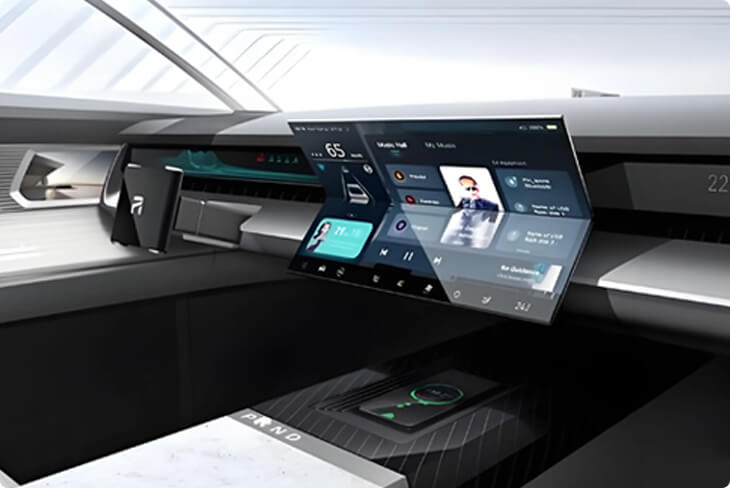
From traditional windshield and window safety glass to today’s center console display covers, AR-HUD head-up display optics, camera protection windows, mirror cover plates, ambient-lighting optical components, and even photovoltaic roof panels in new energy vehicles, glass is no longer 3merely a protective material. It has evolved into a core component that enhances vehicle intelligence, aesthetics, and safety.
This article provides an overview of how glass is used in modern automotive engineering and explores how glass manufacturing technologies are adapting to the increasingly diverse requirements of the fast-growing automotive industry.
Glass is highly favored in automotive manufacturing because of its comprehensive advantages in optical performance, safety protection, aesthetic flexibility, and human–machine interaction.
For HUD systems, panoramic sunroofs, and sensor windows, the high purity and low scattering of glass are especially critical.
They can effectively withstand wind pressure at high speeds, stone impacts, and thermal stress fluctuations.
Through processes such as hot bending, screen printing, coating, and spraying, glass can be shaped and decorated to meet different vehicle designs.
Screen printing enables border masking and pattern decoration, while functional coatings provide AG (anti-glare), AR (anti-reflection), and AF (anti-fingerprint) properties—enhancing both the exterior styling and interior sophistication of the vehicle.
It can integrate capacitive touch, optical sensing, and information display functions, offering intuitive and premium human–machine interaction across dashboards, center consoles, and passenger screens.
According to Grand View Research, the global automotive glass market reached USD 3.648 billion in 2024 and is expected to grow at a CAGR of 4.5% during 2025–2030.
IMARC predicts the market will reach USD 3.13 billion by 2033, with a CAGR of 5.13% from 2025 to 2033. These reports indicate steady long-term growth.
Traditionally, glass accounted for approximately 25–35% of a vehicle's exterior surface. However, with the rapid rise of new energy vehicles (NEVs), the proportion has increased to 40–50%, driven by smart cockpits, photovoltaic roofs, advanced displays, and sensor systems. Not only are windows and roof glazing increasing in usage, but glass is also widely adopted in center control displays;HUD optics; rear-view mirrors; cameras and LiDAR protection windows;interior screen modules. Glass plays an increasingly important role across the entire vehicle architecture.
Lightweighting is a key direction for modern automotive engineering.
Glass contributes significantly to overall vehicle weight, and even slight thickness reductions can meaningfully improve range and energy efficiency.
Most automotive glass now ranges from 1.6–3.0 mm, while chemically strengthened ultra-thin glass can reach 1.0–1.1 mm with sufficient bending strength and stress stability.
In HUD zones, instrument covers, and touch display areas, ultra-thin glass:
reduces optical distortion
enhances projection precision
supports OGS full-lamination for NEV cockpits
increases design freedom
Automotive optics demand clarity, low reflection, and accurate color. Ultra-clear low-iron glass, with Fe₂O₃ content at extremely low levels, achieves:
91–92% visible light transmittance
<0.5% haze
With the adoption of AR-HUDs and multi-screen cockpits, optical coatings are increasingly important:
AR coatings can reduce reflectance from 8% to below 1%
IR and UV filtering coatings protect sensors and improve detection accuracy
AG coating improves visibility under strong ambient light
These coatings enhance safety and support advanced sensing systems.
Automotive design is evolving toward streamlined, integrated forms. This requires advanced shaping technology:
Hot bending enables large-curvature 3D surfaces
CNC machining supports complex cutouts and optical finishing
Precision polishing eliminates distortion after forming
KS Glass offers high-precision hot-bending solutions with uniform stress and zero optical deformation.
Decorative technologies such as screen printing, UV printing, gradient coatings, and mirror finishes allow full customization of borders, logos, and visual effects.In NEVs, glass often becomes part of the vehicle’s exterior design language, integrating seamlessly with photovoltaic panels and wrap-around screens.
In smart cockpits, glass is the primary medium for display and touch interaction:
center displays
digital instrument panels
passenger entertainment screens
rear seat entertainment systems
To ensure usability in varying lighting and temperature conditions, the surface often includes:
AF coating: Reduces fingerprints and improves smoothness
AG coating: Reduces glare via micro-etching or nano-spray
AR + AF composite coatings: Clarity + premium tactile experience
With integrated touch and voice interaction, glass can embed ITO conductive layers for high-precision capacitive control.
Engineering Selection Recommendations
For styling + structural integration → 3D hot-bent tempered ultra-clear glass
For lightweight touch applications → 1.1–1.6 mm chemically strengthened glass
For high visual clarity → AR/AG composite coatings
KS Glass offers comprehensive material and process capabilities including soda-lime ultra-clear, aluminosilicate, and borosilicate glass combined with hot bending, tempering, screen printing, AR/AF/AG coating, and CNC machining—providing full customization for automotive systems.
Glass thickness may further drop to 0.5–1.0 mm through advanced strengthening processes. Benefits include:
Improved range and energy efficiency
Reduced HUD optical distortion
Tighter integration with display modules
More compact, modern cockpit layouts
Automotive glass will evolve from a protective cover into an advanced multifunction platform integrating:
Touch sensing
Optical sensing
Information display
Multi-screen integration and immersive cabin experiences will rely heavily on such composite functional glass.
Future coating systems will be adaptive and multifunctional:
AR/AG/AF multi-layer composites
light-responsive intelligent coatings
IR-blocking and UV-filtering layers
sensor-grade optical coatings
These will improve visibility, safety, and sensor accuracy in all conditions.
Advances in hot bending and CNC machining will support:
high-curvature 3D glass
complex shaped cutouts
seamless integration with PV roofs and exterior displays
Glass will become an essential part of the vehicle's visual identity, especially in NEVs and futuristic cockpit designs.
Automakers increasingly seek customized optical and aesthetic glass:
Gradient printing
Decorative screen-printed borders
Custom logos
Tailored transparency regions
Flexible prototyping and small-batch manufacturing will accelerate personalized design for premium models.
These innovations enhance both functional performance and the emotional experience of next-generation vehicles.
With the rapid development of automotive intelligence, autonomous driving, and new energy technologies, glass has evolved from a passive protective material into a multifunctional structural and optical component essential for modern vehicles.
KS Glass specializes in producing ultra-thin glass, 3D hot-bent glass, screen-printed glass, and functional coated glass for: center console displays,HUD projection systems,automotive cameras,rear-view mirrors,photovoltaic roof systems.
Supported by precision machining, hot bending, CNC processing, and AR/AF/AG coating technologies, KS Glass delivers high-performance, customizable solutions that balance lightweight construction, durability, and visual appeal.
As integrated cockpit design and multifunctional systems continue to expand, KS Glass will remain committed to providing automotive manufacturers with innovative, high-quality glass solutions that drive the evolution of smart and sustainable mobility.
Ready to take your glass project to the next level? Contact us today to discuss your custom glass needs and get a quote!
contact us