
The core components of our daily-used mobile phone screens, tablet covers, and in-car control screens are all made of Cover Glass. It not only needs to withstand impacts and allow light to pass through, but also must meet the highest standards of microscopic cleanliness. A seemingly clean glass surface, if it still has dust with a diameter of only 0.1 microns (equivalent to one-fiftieth of the diameter of a hair strand), the subsequent coating may come off and the touch function may fail; even just a little bit of oil residue will cause the screen's light transmittance to drop by more than 5%. Now, everyone is pursuing thinner, cleaner, and more durable products. Traditional manual wiping and high-pressure spraying cannot meet the requirements of micrometer-level cleanliness. And ultrasonic cleaning, with its advantages of "no dead corners, no damage, and high efficiency", has become the core technology for controlling the microscopic cleanliness of Cover Glass.
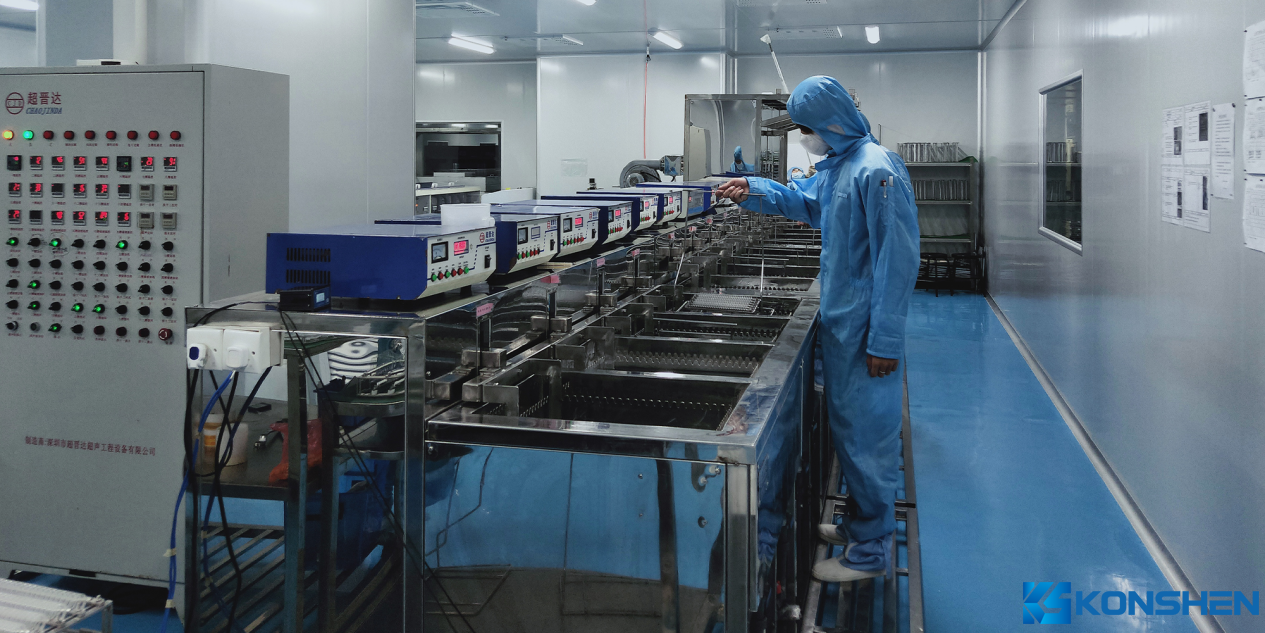
The essence of ultrasonic cleaning is that it uses the "cavitation effect" generated by high-frequency sound waves in the liquid to perform non-contact cleaning on the surface of glass.
When ultrasonic waves with a frequency exceeding 20 kilohertz are introduced into the cleaning solution, they will cause the liquid molecules to vibrate at high speed, forming alternating high-pressure and low-pressure zones. In the low-pressure zone, the liquid is instantly torn apart, creating countless tiny cavitation bubbles with diameters of only 20 to 50 micrometers; in the high-pressure zone, these bubbles will suddenly close, releasing an astonishing amount of energy - the local temperature can reach 5000K (approximately 4727℃), with a pressure over a thousand atmospheres, and also generating a microjet with a speed of 100 meters per second.
This "bubble generation - closure" cycle is like performing billions of micro-blasting operations on the glass surface, which can not only break stubborn oil stains and remove nanometer-sized dust, but also drill into the micro-cracks on the glass surface to clean the deep contaminants. What's more ingenious is that the size of the cavitation bubbles is exactly matched to the microscopic contaminants on the glass surface, which can efficiently remove impurities while not damaging the glass itself - this is the core reason why ultrasonic cleaning is superior to traditional mechanical scrubbing, truly achieving "cleaning and protection without compromise".

The effect of ultrasonic cleaning is not determined by a single parameter, but is the result of the combined effect of factors such as frequency, power, and temperature. Different types of Cover Glass require dedicated "cleaning solutions":
Frequency: The mainstream range is 20 to 45 kilohertz, which can ensure the cavitation effect while not affecting the cleaning efficiency. The lower the frequency, the larger the bubbles and the stronger the impact force, suitable for cleaning stubborn oil stains; the higher the frequency, the finer the bubbles and suitable for removing nanometer-sized dust. For example, when cleaning fingerprint recognition cover glass, a dual-frequency combination of 27.5 kilohertz and 40 kilohertz will be used to balance different types of contaminants.Temperature: The cleaning solution is generally controlled at 50 to 65℃. Increasing the temperature can reduce the surface tension of the liquid, making the cavitation bubbles easier to form, and accelerating the emulsification of oil stains, but exceeding 70℃ will cause the cleaning agent to lose its effectiveness, and the cleaning will get worse instead.
Just relying on plain water, the effect of ultrasonic cleaning is limited. Adding a dedicated cleaning agent can double the cleaning efficiency.
Alkaline cleaning agent (pH value 11-12): contains 2.5% potassium hydroxide or sodium hydroxide, which can quickly dissolve the residual protective ink and inorganic contaminants on the glass surface, with a removal rate of up to 98%;
Environmental chelating agent: can enhance the adsorption capacity for metal impurities, and has a 28-day biodegradation rate of over 90%, meeting the requirements of green production;
Pure water rinsing: Finally, it must be rinsed with ultra-pure water with an electrical resistivity of 18.2 megohms-cm to avoid residual cleaning agents causing secondary pollution.
In the production process of Cover Glass, ultrasonic cleaning is generally carried out after cutting and ink removal, and before tempering and coating. It is a crucial process that connects the previous step with the next one - the microscopic cleanliness it controls directly determines whether the subsequent processes can succeed.
The AF anti-fingerprint coating and AR anti-reflective coating on the surface of Cover Glass have extremely high requirements for the cleanliness of the base material. If there is oil or dust on the glass surface during coating, it will form "false adhesion", and when conducting a peel test with tape, the coating layer is prone to fall off. Ultrasonic cleaning can thoroughly remove these impurities, allowing the glass surface to reach 60-72 millinewtons/meter, and the coating adhesion can be increased by more than 3 times, fully capable of withstanding daily friction and wiping.
Industry test data shows that after ultrasonic cleaning, the wear resistance of the AF coating layer of Cover Glass can increase from 10,000 times to 50,000 times, and the coating defect rate can be reduced from 12% to 1.5%.
Minor contaminants can seriously affect the light transmittance and imaging quality of the glass. For example, dust with a diameter of 0.5 microns will cause light scattering, reducing the screen display contrast; surface oil stains will form a "fog layer", reducing the light transmittance by 5%-8%.
Ultrasonic cleaning can achieve micrometer-level cleanliness, ensuring that the light transmittance of Cover Glass remains above 92%, approaching the theoretical limit. Test data shows that the contact angle of the glass surface after cleaning can drop from 78° to below 30°, reaching the "completely clean" standard (when the contact angle is close to 0°, it indicates no organic contamination).
During the tempering process, impurities on the glass surface will become "stress concentration points", causing the glass to easily crack during tempering; in the silk-screening process, dust will cause ink leakage and pinhole defects. Ultrasonic cleaning can avoid these risks from the source.
Take the production of Gorilla Glass as an example. After using ultrasonic cleaning, the one-time pass rate of AOI (Automatic Optical Inspection) increased from 40% to 95%, and the overall production yield increased by more than 30%, significantly reducing production costs.
The ultrasonic cleaning in the production of Cover Glass is not a simple one-time cleaning process, but a multi-step, refined process design specifically addressing different types of contaminants. The following is a typical cleaning process for fingerprint recognition cover glass (derived from industry patent technology):
|
Process |
Cleaning Medium |
Temperature |
Frequency |
Time |
Core Function |
|
1 |
Basic Cleaning Agent (pH 11-12) |
55 ± 5℃ |
27.5 ± 5kHz |
3min |
Remove ink residue and severe oil stains |
|
2 |
Basic Cleaning Agent (pH 11-12) |
55 ± 5℃ |
28.0 ± 5kHz |
3min |
Reinforce decontamination, remove stubborn impurities |
|
3 |
Ultra-Pure Water |
20 ± 5℃ |
27.9 ± 5kHz |
3min |
Rinse away residual cleaning agent on the surface |
|
4 |
Ultra-Pure Water |
20 ± 5℃ |
39.6 ± 5kHz |
3min |
Remove small molecules of impurities, achieve refined cleaning |
|
5 |
Ultra-Pure Water |
60 ± 5℃ |
39.6 ± 5kHz |
3min |
High-temperature rinsing to accelerate water evaporation |
|
6 |
Ultra-Pure Water |
65 ± 5℃ |
40.0 ± 5kHz |
3min |
Final cleaning treatment to enhance surface energy |
|
7 |
Slow Drying and Dehydration |
75 ± 5℃ |
- |
1min |
Utilize surface tension to avoid water stains |
|
8 |
Drying |
135 ± 5℃ |
- |
8min |
Complete drying to ensure no water residue |
The core design of this process is first use a chemical solution to remove impurities, then rinse with pure water, and through different frequencies and temperatures, it achieves targeted removal of different types of contaminants. For example, low-temperature pure water cleaning can prevent impurities from re-attaching due to high temperatures, high-frequency cleaning can precisely remove tiny dust particles, and slow-drying dehydration can perfectly solve the water stains problem of ultra-thin glass.
In addition, for ultra-thin Cover Glass of 0.1-0.25 millimeters, a gentle mode is adopted - reducing the sound intensity to 1-2 watts/square centimeter to avoid excessive cavitation effect that could cause glass bending and damage, truly achieving a balance between cleaning and protection.
Before the widespread use of ultrasonic cleaning technology, Cover Glass production mainly relied on manual scrubbing and high-pressure spraying as traditional methods, but these methods had obvious shortcomings and could not meet the requirements of microscopic cleanliness:
Cleaning method Cleanliness (residual contaminants) Cleaning efficiency Glass damage risk Applicable scenariosUltrasonic cleaning ≤0.02mg/cm² (micron level) 6-8 minutes / basket No damage Batch production, precise cleanliness requirements
High-pressure spraying 0.5mg/cm² (surface level) 15 minutes / piece May scratch the glass edge Coarse cleaning, large glass processing
Manual scrubbing 0.3mg/cm² (unstable) 30 minutes / piece High (likely to leave scratches) Low batch, non-standard part processing
The data clearly shows that the cleanliness of ultrasonic cleaning is 25 times that of high-pressure spraying, the efficiency is more than 5 times that of manual scrubbing, and it can achieve fully automated assembly line operations, fully adapting to the large-scale production of Cover Glass. More importantly, its non-contact cleaning feature can protect the fragile edges and surfaces of Cover Glass, avoiding scratches, chipping (in the industry, scratches longer than 0.1 millimeters are judged as defective products) caused by traditional scrubbing.
As Cover Glass develops towards thinner, stronger, and multi-functional directions, ultrasonic cleaning technology is also constantly upgrading:
Intelligent adaptive cleaning: Through machine vision to capture the types and distribution of contaminants on the glass surface in real time, dynamically adjust frequency, power, and cleaning agent formula, cleaning efficiency can be increased by 1.5 times;
Environmental upgrading: Developing biodegradable green cleaning agents to replace traditional chemical reagents, reducing wastewater treatment costs, and adopting a closed water circulation system to increase water resource utilization to over 95%;
Process integration: Integrating ultrasonic cleaning with coating, drying, and other processes, reducing secondary pollution during glass transfer and shortening the production process;
Nanometer-level cleanliness control: Developing 100 kilohertz or higher high-frequency ultrasonic cleaning technology for flexible Cover Glass and quantum dot glass, achieving precise removal of nanometer-level contaminants.
A high-quality Cover Glass cannot be produced without the meticulous polishing of ultrasonic cleaning technology. From the screens of our mobile phones to the building facades of tall buildings, from in-vehicle display devices to optical instruments in the aerospace field, ultrasonic cleaning, with its unique ability to achieve microscopic cleanliness, safeguards the stable performance and safety of each piece of glass.
The cleanliness in the microscopic world, although invisible to the naked eye, directly determines the quality and lifespan of the product. The development of ultrasonic cleaning technology not only promotes the progress of Cover Glass production but also highlights the craftsmanship wisdom in industrial production - details determine success or failure, even micro-micron impurities cannot be careless. In the future, with continuous technological innovation, we will see thinner, clearer, and more durable Cover Glass products, and ultrasonic cleaning will always be the indispensable cleaning guardian behind it.
Ready to take your glass project to the next level? Contact us today to discuss your custom glass needs and get a quote!
contact us