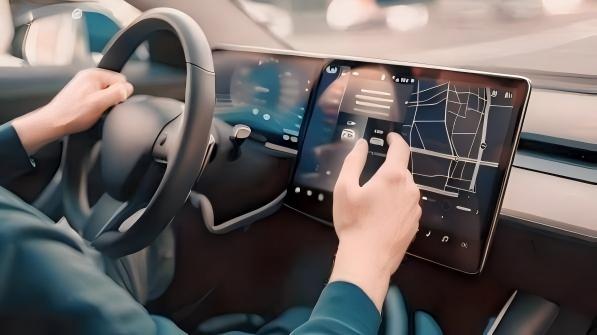
The automotive interior landscape is undergoing a monumental paradigm shift driven by vehicle electrification, autonomous driving capabilities, and software-defined vehicle architectures. Central to this interior transformation is the human-machine interface, which has evolved from modest, isolated center-stack screens into expansive, multi-display digital cockpits. Modern vehicles now feature seamless, pillar-to-pillar cockpit displays, co-driver interactive screens, digital instrument panels, and rear-seat entertainment modules.
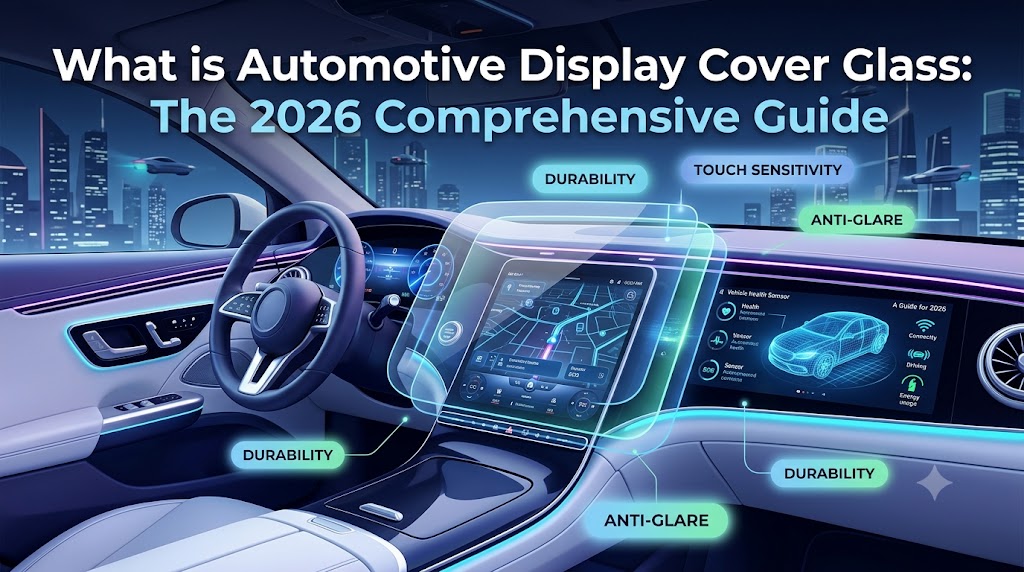
At the forefront of this digital cockpit evolution is the display cover glass. Serving as the outermost interface between vehicle occupants and the underlying display technology, the display cover glass is no longer a passive protective layer. It is a highly engineered optical component that must simultaneously satisfy stringent head-impact safety standards, deliver zero-reflection optical readability under extreme ambient lighting, endure decades of chemical and mechanical stress, and complement modern automotive aesthetics through complex three-dimensional contours. This guide provides an exhaustive analysis of automotive display cover glass technologies, material science, manufacturing processes, testing protocols, and future market trajectories for 2026 and beyond.
1. What is Automotive Display Cover Glass?
1.1 What is Display Cover Glass?
In automotive display engineering, the display cover glass refers to the transparent, rigid outer substrate mounted directly over the display stack-up. Unlike consumer electronics cover glass found on handheld smartphones, automotive-grade display cover glass operates under far more severe environmental and structural constraints. The display cover glass acts as the primary physical barrier protecting delicate touch sensors and liquid crystal displays or organic light-emitting diode panels from mechanical impacts, occupant contact, thermal extremes, and ultraviolet degradation over a vehicle’s multi-decade operational lifespan.
1.2 Structure of Automotive Display Modules
To understand the functional role of the display cover glass, one must examine the modern laminated automotive display module stack-up. At the front of the assembly is the outer display cover glass, which is treated with specialized surface coatings including Anti-Glare, Anti-Reflective, and Anti-Fingerprint functional layers. Positioned immediately behind the display cover glass is an optical bonding adhesive layer utilizing Optical Clear Adhesive or Liquid Optical Clear Adhesive compounds such as silicone or epoxy resins.
Behind the adhesive lies the touch sensor substrate, typically utilizing Projected Capacitive technology with fine-line metal mesh or Indium Tin Oxide conductive patterns. This sensor layer is laminated directly onto the Thin-Film Transistor Liquid Crystal Display or Active-Matrix Organic Light-Emitting Diode panel. In liquid crystal display systems, a high-luminance Mini-LED or edge-lit LED backlight unit sits behind the panel, and the entire assembly is enclosed within a die-cast magnesium or aluminum structural housing that provides mechanical rigidity and thermal dissipation.
By implementing optical bonding to laminate the display cover glass directly to the underlying display panel, optical engineers eliminate the internal air gap that traditionally caused double reflections. Eliminating this internal air gap prevents condensation and fogging in high-humidity cabin environments while dramatically improving sunlight readability and overall impact resistance.
1.3 Why is Cover Glass Important?
The display cover glass plays a critical role in modern vehicle cockpits across multiple engineering disciplines. From an occupant safety perspective, the display cover glass must absorb severe impact energy during collisions without fracturing into sharp, dangerous splinters that could injure passengers, adhering strictly to automotive interior crash safety standards.
From an optical perspective, direct ambient sunlight entering vehicle cabins can exceed 100,000 lux. The display cover glass must modulate surface reflections to maintain display contrast and legibility without distracting the driver. Furthermore, the display cover glass provides the precise surface tactile properties required for fluid touch gestures and active haptic feedback systems, while enabling sweeping curved dashboard architectures that visually integrate display hardware into the interior design.
2. Applications of Automotive Display Cover Glass
2.1 Center Information Display (CID)
The Center Information Display remains the primary interface for infotainment, navigation, climate settings, and vehicle system configurations. Because the Center Information Display experiences the highest frequency of physical touch interaction in the cabin, its display cover glass requires exceptional scratch resistance, superior anti-fingerprint properties, and high resistance to finger oils and interior cleaning agents.
2.2 Digital Instrument Clusters
Positioned directly in the driver’s primary line of sight, the digital instrument cluster displays critical safety information such as vehicle speed, driver-assistance alerts, and diagnostic warnings. The display cover glass used for digital instrument panels prioritizes non-glare visual performance and maximum light transmission to guarantee split-second legibility under rapidly changing ambient lighting conditions.
2.3 Head-Up Displays (HUD)
In modern automotive Head-up display architectures, specialized glass optical elements—including flat combiners, curved mirrors, and glare shields—redirect projected images from the picture generation unit onto the vehicle windshield. The display cover glass elements within these optical paths require extreme surface flatness, specialized wavelength-selective reflective coatings, and tight geometric tolerances to eliminate visual distortion and ghosting.
2.4 Passenger Displays
Co-driver passenger displays allow front seat occupants to view entertainment content, stream video, or interact with navigation functions. The display cover glass for passenger screens often integrates active or passive privacy filtering technologies, such as micro-louver films embedded within the glass lamination, which block viewing from the driver’s perspective to prevent driver distraction while the vehicle is in motion.
2.5 Rear-Seat Entertainment Displays
Mounted on front seatbacks or center consoles, rear seat entertainment screens cater to rear-seat passengers. The display cover glass on rear displays experiences high exposure to accidental mechanical impacts from knees, loose cabin cargo, or child activity. Consequently, rear display cover glass demands elevated impact resistance and shatter-proof safety lamination to prevent fragment ejection upon impact.
2.6 Smart Control Panels
Replacing traditional physical switchgear, smart touch panels are increasingly integrated into center consoles, door trims, and overhead control modules. These control interfaces utilize three-dimensionally shaped display cover glass featuring complex surface contours, integrated physical dial cutouts, and embedded haptic actuators that provide tactile feedback upon capacitive touch activation.
3. Performance Requirements for Automotive Display Cover Glass
| Performance Metric | Industry Benchmark | Testing Standard | Primary Objective |
| Optical Transmittance | > 92% (with AR coating) | ISO 13468 / ASTM D1003 | Maximize display luminance and energy efficiency |
| Specular Gloss (AG) | 35 – 70GU (60°angle) | ASTM D523 | Scatter bright ambient sunlight reflections |
| Luminous Reflectance | < 1.5% (down to <0.5%) | ISO 2813 / ISO 13468 | Eliminate mirror glare in direct sunlight |
| Water Contact Angle (AF) | > 110°initial (>100°aged) | ASTM C1060 | Maintain easy-to-clean anti-fingerprint surface |
| Compressive Stress (CS) | > 750 MPa | FSM-6000 Optical Stress | Prevent fracture under high mechanical loading |
| Depth of Layer (DOL) | > 40um | Optical Waveguide Spec | Prevent deep surface scratch propagation |
| Impact Strength | 227g steel ball drop from 1.5m | ISO 6272 / SAE J2581 | Ensure occupant safety during cabin impact |
| Thermal Operating Range | -40℃ to +105℃ | DIN EN 60068-2-14 | Withstand cabin extreme thermal cycling |
3.1 Optical Clarity
Automotive display modules must render crisp, high-definition visuals without visual distortion. High-performance display cover glass must deliver luminous transmittance exceeding 91%—and over 95% when enhanced with multi-layer anti-reflective coatings—while maintaining low optical haze below 1.5% and zero chromatic aberration across wide viewing angles.
3.2 Anti-Glare (AG) Performance
Anti-glare surface treatments transform the smooth surface of the display cover glass into a micro-etched topography. When ambient sunlight strikes an anti-glare treated display cover glass, incoming specular reflections are diffusely scattered into low-intensity ambient light. Chemical acid etching is the automotive industry standard for producing uniform micro-structures that eliminate unwanted reflections while preventing display sparkle or pixel shimmer artifacts.
3.3 Anti-Reflective (AR) Performance
While anti-glare treatments scatter reflected light, anti-reflective coatings actively neutralize reflections through destructive wave interference. Applying thin-film vacuum coatings—such as alternating nanometer-scale layers of silica, titanium dioxide, or magnesium fluoride—matches the refractive index between air and glass. This optical interference structure reduces surface reflectance from approximately 4% per bare glass surface down to below 0.5%.
3.4 Anti-Fingerprint (AF) Performance
Human finger oils and skin lipids readily smudge display surfaces, degrading optical legibility and aesthetic cleanliness. Anti-fingerprint coatings—typically composed of ultra-thin perfluoropolyether fluorosilane nanocoatings applied via chemical vapor deposition—impart strong hydrophobic and oleophobic surface properties to the display cover glass. Maintaining a water contact angle above 110° ensures that finger oils do not easily adhere and can be wiped away effortlessly.
3.5 Scratch and Impact Resistance
Vehicle cabin surfaces endure continuous contact from rings, fingernails, keys, and cleaning tools. The display cover glass must demonstrate exceptional scratch resistance, achieving a minimum pencil hardness rating of 7H to 8H. Furthermore, the display cover glass must withstand high mechanical impact loads, which is achieved by subjecting the glass to chemical strengthening processes that introduce deep compressive surface stress layers.
3.6 High Temperature and Weather Resistance
Automotive cabin environments experience severe temperature swings, ranging from -40℃in freezing climates to +85℃ in standard operation, and up to +105℃ in direct solar soak areas beneath the windshield. The display cover glass, along with its underlying decorative inks and optical bonding materials, must resist thermal shock, mismatch expansion stresses, delamination, and yellowing caused by sustained ultraviolet radiation exposure.
3.7 Chemical Resistance
The outer surface of the display cover glass must remain chemically inert when exposed to aggressive household and automotive fluids. Essential testing verifies that functional coatings on the display cover glass do not degrade when exposed to hand lotions, sunscreens containing titanium dioxide or zinc oxide, ethanol-based cleaning agents, carbonated beverages, synthetic interior dressings, or artificial sweat.
3.8 Long-Term Reliability
Automotive platforms are engineered for operational service lives ranging between 10 and 15 years. All functional surface coatings, ceramic decorative inks, and structural adhesive bonds applied to the display cover glass must maintain their mechanical integrity and optical performance throughout the vehicle’s lifespan without peeling, cracking, or degrading.
4. Best Glass Materials for Automotive Displays
Selecting the optimal raw material for display cover glass requires balancing mechanical strength, optical performance, formability into complex shapes, and overall manufacturing costs.
4.1 Soda-Lime Glass
Composed primarily of silica, soda, and lime, standard soda-lime glass accounts for roughly 90% of globally manufactured flat glass products. Although soda-lime glass is highly economical and straightforward to manufacture, its thermal expansion coefficient is relatively high, and its achievable compressive stress following chemical strengthening is limited compared to advanced formulations. Consequently, soda-lime display cover glass is largely restricted to cost-sensitive, flat entry-level automotive displays.
4.2 Aluminosilicate Glass
Formulated by incorporating substantial percentages of alumina (typically 10% to 20%) into the silicate matrix, aluminosilicate glass provides vastly superior mechanical strength, thermal shock resistance, and chemical durability. The aluminum ions within the glass network facilitate significantly faster ion-exchange rates during chemical tempering, enabling the formation of deeper compressive stress layers and higher surface compression. This makes aluminosilicate glass a highly popular substrate for mid-to-high-end automotive display cover glass applications.
4.3 Gorilla Glass
Engineered by Corning Incorporated, Gorilla Glass represents a specialized family of alkali-aluminosilicate glass compositions optimized specifically for maximum damage resistance and optical clarity. Utilizing high-purity batch materials and proprietary ion-exchange strengthening processes, Gorilla Glass achieves surface compressive stress levels exceeding 850 MPa and depth of layer penetration beyond 40 micrometers. Its exceptional flexural strength and thin-profile durability make it an ideal choice for complex three-dimensional bent automotive display cover glass designs.
4.4 Chemically Strengthened Glass
Unlike standard thermal tempering—which quenches hot glass using rapid air streams and often induces thermal warping and optical distortion—chemically strengthened glass utilizes a low-temperature chemical ion-exchange mechanism. Submerging the glass sheet into a bath of molten potassium nitrate salt causes smaller sodium ions near the glass surface to be replaced by larger potassium ions from the bath. This ion exchange wedge effect creates a uniform, high-compression outer layer without inducing optical bowing or structural distortion.
4.5 Material Comparison
| Technical Property | Soda-Lime Glass | Standard Aluminosilicate | High Aluminosilicate | Thermally Tempered Glass |
| Silica Content | 70 – 74% | 60 – 65% | 60 – 64% | 70 – 74% |
| Alumina Content | 0.5 – 1.5% | 10 – 15% | 16 – 20% | 0.5 – 1.5% |
| Compressive Stress (CS) | 300 – 450 MPa | 600 – 750 MPa | 800 – 950 MPa | 69 – 150 MPa |
| Depth of Layer (DOL) | 10 – 20um | 30 – 45um | 40 – 60um | N/A |
| Scratch Resistance (Mohs) | 5.5 – 6.0 | 6.5 – 7.0 | 7.0 – 7.5 | 6.0 |
| Flexural Bending Strength | Moderate | High | Exceptional | High (Distorted) |
| Optical Distortion / Warp | Minimal | Minimal | Zero Distortion | Moderate to High |
| Relative Material Cost | Low (1.0x) | Medium (2.5x) | Premium (4.0x) | Low (1.2x) |
5. Manufacturing Processes of Automotive Display Cover Glass
5.1 Glass Cutting and CNC Machining
The manufacturing flow for an automotive display cover glass begins with raw float glass sheets. High-precision mechanical scribing using diamond wheels or non-contact thermal cutting using picosecond or femtosecond lasers cuts the master glass sheets into precise blank geometries. Laser cutting is increasingly favored for advanced display cover glass production because it leaves pristine cut edges with minimal micro-cracking, preserving high intrinsic edge strength. Following initial cutting, high-speed Computer Numerical Control milling machines carve internal cutouts, camera windows, mounting slots, and mechanical holes for physical control dials.
5.2 Edge Grinding and Polishing
Unfinished cut glass edges contain microscopic fractures that act as stress concentration points, leaving the glass vulnerable to premature failure under mechanical impact. CNC grinding systems shape the raw edges of the display cover glass into smooth 2.5D C-shape or R-shape profiles using diamond-impregnated grinding wheels. Subsequent chemical or mechanical polishing operations eliminate sub-surface damage, raising the flexural strength of the glass edges to match the strength of the main surface.
5.3 Chemical Strengthening
To establish high impact resistance, the CNC-machined display cover glass undergoes chemical strengthening via molten salt ion exchange. The shaped glass parts are preheated and submerged in large stainless steel tanks containing molten potassium nitrate (KNO) salt maintained at temperatures between 380℃ and 450℃.
During this immersion, sodium ions (Na+) near the surface of the display cover glass diffuse out into the salt bath, while larger potassium ions (K+) from the bath migrate into the glass surface matrix. Because the larger potassium ions occupy more volume than the original sodium ions, intense residual compressive stress develops in the surface layer upon cooling, effectively sealing micro-flaws and preventing crack propagation.
5.4 Screen Printing
To conceal internal mounting hardware, wiring harnesses, and display bezels, a opaque decorative border—known as the Black Matrix—is screen-printed onto the backside perimeter of the display cover glass. High-temperature ceramic enamel inks or organic UV-curable inks are deposited through precision mesh screens and vitrified in curing ovens. Ceramic inks bond permanently with the display cover glass surface, offering exceptional resistance to chemical attack and environmental degradation over the vehicle’s lifespan.
5.5 AG, AR, and AF Surface Coatings
Functional surface coatings are applied to the display cover glass to optimize optical legibility and tactile performance. Anti-Glare properties are typically created first by submerging the glass in hydrofluoric acid solutions to chemically etch a microscopic surface roughness that diffuses specular reflections.
Next, Anti-Reflective properties are added by depositing multi-layer dielectric thin films of alternating high and low refractive index materials onto the display cover glass using vacuum magnetron sputtering.
Finally, Anti-Fingerprint properties are imparted by applying a nanometer-thin layer of perfluoropolyether fluorosilane via chemical vapor deposition, creating a durable hydrophobic and oleophobic outer barrier on the display cover glass.
5.6 Quality Inspection
Every completed display cover glass undergoes rigorous automated inspection before shipment. High-resolution Automated Optical Inspection systems inspect the glass for surface scratches, particulate inclusions, coating voids, and ink pinholes. In addition, non-destructive optical stress meters, such as FSM-6000 instruments, measure the surface Compressive Stress and Depth of Layer on the display cover glass to verify full compliance with engineering specifications.
6. Flat vs. Curved Automotive Display Glass
6.1 Advantages of Flat Glass
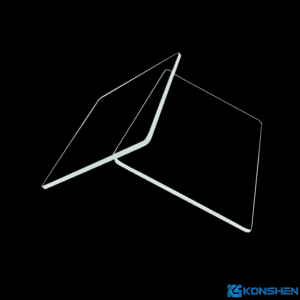
Flat display cover glass designs remain widely deployed across the automotive industry due to several manufacturing and economic benefits. Flat display cover glass processing relies on established, high-yield float glass fabrication lines, resulting in lower unit manufacturing costs and shorter production cycle times.
Furthermore, flat-to-flat optical bonding of flat display cover glass to display panels using liquid adhesives or optical clear adhesive sheets achieves near-100% lamination yield with minimal risk of air bubble entrapment. The simplified packaging, handling, and shipping logistics associated with flat glass further reduce total system costs.
6.2 Advantages of Curved/3D Glass
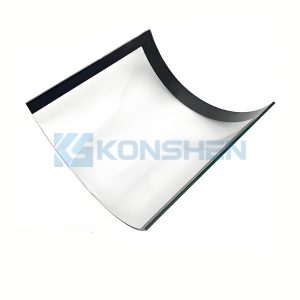
Curved and three-dimensionally shaped display cover glass designs—incorporating single-axis curves, S-shape contours, or complex double-curved geometries—offer compelling design and functional advantages for modern vehicle interiors. Curved display cover glass enables driver-centric display architectures, angling screen controls toward the driver’s natural line of sight and reach to enhance ergonomic HMI interaction.
Visually, 3D curved display cover glass allows automotive designers to integrate instrumentation, central navigation, and passenger entertainment screens into a single continuous, flowing dashboard surface. Additionally, angling curved glass surfaces downward or away from passenger windows effectively redirects direct sunlight reflections away from the driver’s eyes.
6.3 Which is Better?
Determining whether flat or curved display cover glass is superior depends entirely on the vehicle segment, interior design philosophy, and target production budget. Flat display cover glass remains the optimal choice for standard instrument clusters, rear-seat entertainment modules, budget-conscious vehicle models, and commercial vehicle fleets where manufacturing cost, high processing yield, and straightforward serviceability are primary concerns.
Conversely, curved 3D display cover glass is the preferred solution for premium luxury vehicles, flagship EV platforms, and integrated pillar-to-pillar display cockpits where seamless design integration, interior luxury aesthetics, and advanced ergonomics are paramount.
7. Quality Standards and Testing
7.1 Optical Inspection
Optical testing ensures that functional surface treatments applied to the display cover glass do not compromise visual performance. Spectrophotometers utilizing integrating spheres measure total light transmittance and haze in accordance with ASTM D1003 standards.
Specular gloss meters evaluate the micro-etched surface of the anti-glare display cover glass at a 60° incident angle to verify uniform scattering according to ASTM D523. Furthermore, spectrophotometric colorimeters measure angular color shift (Delta E) across the anti-reflective coated display cover glass to ensure color neutrality under varying ambient viewing angles.
7.2 Impact Resistance Testing
To verify occupant safety during collisions or cabin impacts, the display cover glass undergoes rigorous mechanical impact testing. In steel ball drop tests, a 227-gram or 500-gram solid steel ball is dropped from heights of 1.0 to 1.5 meters directly onto the center and unsupported edges of the optically bonded display cover glass assembly. The glass must resist fracturing or, if broken, must remain fully bonded to the adhesive interlayer without ejecting sharp shards into the cabin.
Full-scale headform impact tests, governed by regulatory standards such as FMVSS 201 and ECE R21, simulate occupant head strikes against the display cover glass to evaluate deceleration forces, energy absorption, and fragment retention.
7.3 Scratch Resistance Testing
The scratch resistance of the display cover glass is evaluated using standardized pencil hardness tests, in which calibrated technical pencils ranging from 1H to 9H are pushed across the glass surface under a 750-gram load at a 45° angle.
To evaluate coating durability, steel wool abrasion testing subjects the anti-fingerprint coating on the display cover glass to reciprocal scrubbing under a 1000-gram load using fine $0000\#$ steel wool pads for 2,000 to 5,000 cycles. Following abrasion, the display cover glass must retain a water contact angle exceeding 100°.
7.4 Thermal Shock Testing
To verify thermal reliability, sample assemblies containing the display cover glass are placed in environmental test chambers and subjected to rapid temperature cycling between -40℃ and +105℃ with short transition times. This test verifies that thermal expansion mismatches between the display cover glass, ceramic inks, structural adhesives, and display panels do not induce stress cracking, optical distortion, or layer delamination.
7.5 Environmental Reliability Testing
Long-term environmental durability is evaluated by exposing the display cover glass to damp heat conditions maintained at +85℃ and 85% relative humidity for 1,000 consecutive hours. This exposure verifies that optical bonding adhesives and functional surface coatings resist moisture ingress, bubbling, and delamination. Furthermore, QUV accelerated weathering tests expose the display cover glass to intense ultraviolet radiation to ensure that decorative inks and anti-fingerprint topcoats do not yellow, degrade, or lose adhesion over time.
8. Future Trends in Automotive Display Glass
8.1 Larger Integrated Pillar-to-Pillar Displays
The automotive industry is rapidly transitioning toward massive, seamless pillar-to-pillar display surfaces that span up to 1.5 meters across the entire vehicle dashboard. These expansive displays utilize a single, continuous piece of display cover glass that houses the digital instrument cluster, central infotainment screen, and co-driver entertainment panel underneath a unified glass surface. Manufacturing these extra-large display cover glass panels requires advanced float glass forming, ultra-precise CNC machining, and specialized multi-zone chemical strengthening tanks.
8.2 Ultra-Thin Glass (UTG)
Ultra-Thin Glass substrates—featuring glass thicknesses below 100 micrometers—are emerging as a transformative material for next-generation vehicle cockpits. Ultra-Thin Glass combines the high scratch resistance, optical clarity, and chemical durability of traditional glass with extreme mechanical flexibility. Integrating Ultra-Thin Glass into automotive display cover glass assemblies enables dynamic morphing controls, bendable dashboard displays, and retractable touch panels that physically adapt to driver preferences.
8.3 Curved and Three-Dimensional (3D) Glass Surfaces
Advanced thermal hot-bending and precision cold-forming technologies are expanding the geometric possibilities for automotive display cover glass. Hot-bending shapes glass at elevated softening temperatures to achieve tight radius curves, while cold-forming bends thin chemically strengthened glass at ambient temperatures during display module assembly. These processes allow 3D curved display cover glass to follow complex interior trim lines while maintaining optical clarity and mechanical integrity.
8.4 Smart Functional Coatings
Future automotive display cover glass surfaces will integrate active, multi-functional coating technologies. Active electrochromic dimming coatings will dynamically modulate light transmission through the display cover glass to eliminate blinding glare in real time.
Integrated haptic surface channels will provide localized physical tactile cues over touch controls. Self-healing oleophobic coatings will use ambient cabin heat to repair surface micro-scratches in the anti-fingerprint layer, while embedded silver-ion matrix coatings will provide continuous antimicrobial surface protection on shared display screens.
8.5 Sustainable Manufacturing Practices
Environmental sustainability is becoming a critical procurement requirement for Tier-1 suppliers and automotive OEMs. Future trends in display cover glass manufacturing focus on implementing low-energy cold-forming bending techniques to replace energy-intensive thermal hot-bending ovens.
Additionally, glass fabricators are adopting closed-loop recycling systems for molten potassium nitrate salt baths used in chemical strengthening, alongside eco-friendly, zero-discharge acid etching technologies that eliminate hazardous chemical waste during anti-glare processing.
Conclusion
The automotive display cover glass has evolved from a basic physical shield into an essential optical, mechanical, and aesthetic component of the modern digital cockpit. As vehicle interiors adopt larger, curved, and fully integrated pillar-to-pillar screen architectures, selecting advanced materials—such as chemically strengthened alkali-aluminosilicate glass—and applying high-performance AG, AR, and AF surface coatings will remain paramount. By balancing crash safety compliance, high sunlight legibility, and complex 3D visual styling, automotive engineers can optimize the display cover glass to deliver immersive, robust human-machine interfaces for 2026 and beyond.