
Content:
Introduction
1. Revealing Special-Shaped Glass: Why It's Popular
1.1 Key Advantages and Value of Special-Shaped Glass
1.1.1 Enhanced Design Freedom
1.1.2 Stronger Functional Integration
1.1.3 Premium Visual and Touch Experience
1.2 Case Study of Special-Shaped Glass
2. Cutting Processes for Special-Shaped Glass
2.1 Cutting Principles
2.2 Cutting Tools
2.2.1 Laser Cutting Machines
2.2.2 CNC Glass Machining Centers
2.2.3 Waterjet Cutting Machines
2.3 Typical Cutting Challenges
2.3.1 Challenge 1: Edge chipping, microcracks, and breakage in ultra-thin glass
2.3.2 Challenge 2: Small R-angles and unstable curved contour accuracy
2.3.3 Challenge 3: Complex shapes with multiple curves and dense holes complicate tool path planning
2.3.4 Challenge 4: Tight dimensional tolerances with potential equipment positioning deviations
2.3.5 Challenge 5: Invisible microcracks difficult to detect, affecting subsequent processes
3. Additional Processing Challenges of Shaped Glass
3.1 Edge Grinding Challenges
3.2 Tempering Challenges
3.3 Printing Challenges
3.4 Coating Challenges
4. Inspection Methods and Tools for Shaped Glass
4.1 Dimensional and Contour Inspection
4.2 Edge and Surface Quality Inspection
4.3 Printing and Coating Inspection
5. Quality Control System for Shaped Glass
5.1 IQC: Incoming Material Inspection
5.2 IPQC: In-Process Quality Control
5.3 OQC: Final Inspection and Full-Size Verification
5.4 Reliability Testing
5.4.1 Drop Test
5.4.2 Salt Spray and Chemical Corrosion Test
5.4.3 Thermal Shock Test
5.4.4 Surface Wear and Scratch Resistance Test
6. Cost Factors of Shaped Glass
6.1 Raw Material
6.2 Shape Complexity
6.3 Multi-color Screen Printing
6.4 Processing Method
6.5 Yield Factors
7. Why Choose US
Conclusion
With the growing demand in industries such as smart hardware, automotive displays, industrial control, and medical terminals for lightweight, high-precision, and multifunctional integrated structural components, special-shaped glass has become a key material in many product designs. Compared to conventional rectangular glass, special-shaped glass features more complex exterior contours, hole structures, curved radii, and surface treatments, placing higher requirements on cutting accuracy, process path control, and production stability.
For glass manufacturers, B2B procurement personnel, and R&D engineers, a thorough understanding of the processing principles, technological constraints, precision control methods, and key factors affecting cost and yield of special-shaped glass is crucial. This knowledge supports design for manufacturability (DFM), risk reduction, supply chain optimization, and selection of suitable processing techniques.
This article systematically reviews the key cutting technologies for special-shaped glass, process challenges, precision control strategies, inspection methods, and quality systems, and analyzes the main factors affecting final costs. It provides a comprehensive technical framework of reference for the development, procurement, and manufacturing of special-shaped glass components in various industrial and electronic products.
Special-shaped glass (Shaped Glass/Custom Glass) refers to non-standard rectangular or square glass, processed through cutting, edge grinding, laser machining, CNC, and other techniques to achieve specific contours or structural functionalities.
Its main characteristics include:
Non-linear shapes: oval, circular, irregular curves, cut corners, and custom contours
Complex structures: including through holes, slots, blind holes, recessed areas, stepped edges, and multiple R-angle combinations
Integrated surface treatments: such as thermal bending, screen printing, tempering, AR/AF/AG coatings
Special-shaped glass allows industrial designers to break free from the constraints of right-angled appearances, enabling smoother and more elegant shapes. Additionally, thermal bending can create 3D curved surfaces, supporting chamfered edges and complex contours. For smart devices, automotive equipment, consumer electronics, and medical terminals, special-shaped glass not only enhances the visual appeal of industrial design but also improves user experience through printing, thermal bending, and coating processes.
Special-shaped glass can accommodate complex structures, such as curved edges, stepped edges, through holes, and blind holes. Through thoughtful design, designers can optimize functional layout without increasing overall volume, resulting in thinner, more compact devices while reducing redundant components. The glass itself can act as a functional support, decreasing the number of subsequent structural parts, simplifying assembly, and minimizing potential errors.
Special-shaped glass inherits traditional glass advantages, including high light transmittance, smooth touch, and high strength, while overcoming shape customization limits of conventional glass. This gives it an edge over PET, PMMA, metal, and other flexible materials in advanced industrial design.
Combined with AR/AG coatings, it can further enhance optical clarity and reduce reflections. AF (anti-fingerprint) or AS (anti-scratch) coatings extend its service life while maintaining aesthetic appeal and tactile performance. Smooth curved surfaces and well-designed edges also improve handling comfort and reduce accidental touches.
For smartphones, tablets, automotive displays, and medical touch devices, visual and tactile experiences directly influence user satisfaction, making them key differentiators in high-end products.
Over the past 20 years, our KS Glass team has led numerous special-shaped glass projects across medical diagnostics, optical instruments, automotive, and consumer electronics. Throughout this period, we encountered and overcame various processing challenges, continuously improving our techniques, equipment, and yield management while accumulating valuable practical experience.
Project A: Mouse Cover Glass
Overview: This project used ultra-clear glass, which was first processed with an AG (Anti-Glare) etching. Initial shaping and edge processing were performed via laser cutting and CNC machining. Graphene molds were then used for thermal bending to match ergonomic design. Finally, chemical strengthening and AF coating were applied for anti-fingerprint performance.
Challenge 1: AG Parameter Adjustment
AG etching is crucial for balancing haze, clarity, and touch. Minor deviations in etching solution concentration, temperature, or duration can result in excessive haze or insufficient glare reduction. Uniformity of etching depth and microstructure is essential; otherwise, localized sand shedding may occur during subsequent laser cutting, cleaning, or thermal bending. AG surface integrity is sensitive to cleaning methods, contact pressure during thermal bending, and sand layer strength. Optimization must coordinate etching depth, microstructure uniformity, and cleaning process to ensure stability throughout bending and strengthening.
Challenge 2: Edge Precision Control
Despite the mouse cover's small size, edge contour accuracy is critical. Laser-cut burrs must be refined via CNC multi-path optimization to ensure dimensional convergence. Misalignment can create uneven gaps during assembly. Stress concentration zones must be pre-adjusted before chemical strengthening to prevent microcracks. Edge processing precision determines whether thermal bending succeeds and achieves seamless assembly with the mouse casing.
Challenge 3: Curvature Control
The mouse cover features a complex curvature rather than a fixed radius. Graphene mold thermal stability and uniform heat distribution directly affect curvature consistency. Heating temperature and holding time must be finely controlled; insufficient softening or over-flowing glass may lead to poor demolding. Post-bend spring-back must be calculated and matched to 3D design through multiple iterations. Thickness uniformity is critical in compound curvature areas to avoid dimples or optical distortions. Thermal bending defines the overall appearance quality, demanding higher precision than typical industrial panels.
Project B: Blood Pressure Monitor Watch Cover
Overview: For an international wearable brand, KS Glass manufactured a 0.5 mm ultra-thin special-shaped glass cover for a blood pressure monitoring watch. Laser cutting achieved precise, small curved edges while maintaining a lightweight, rounded appearance. Chemical strengthening enhanced surface compressive stress (CS) and edge impact resistance. Custom screen printing ensured high opacity and adhesion for functional sensor windows.
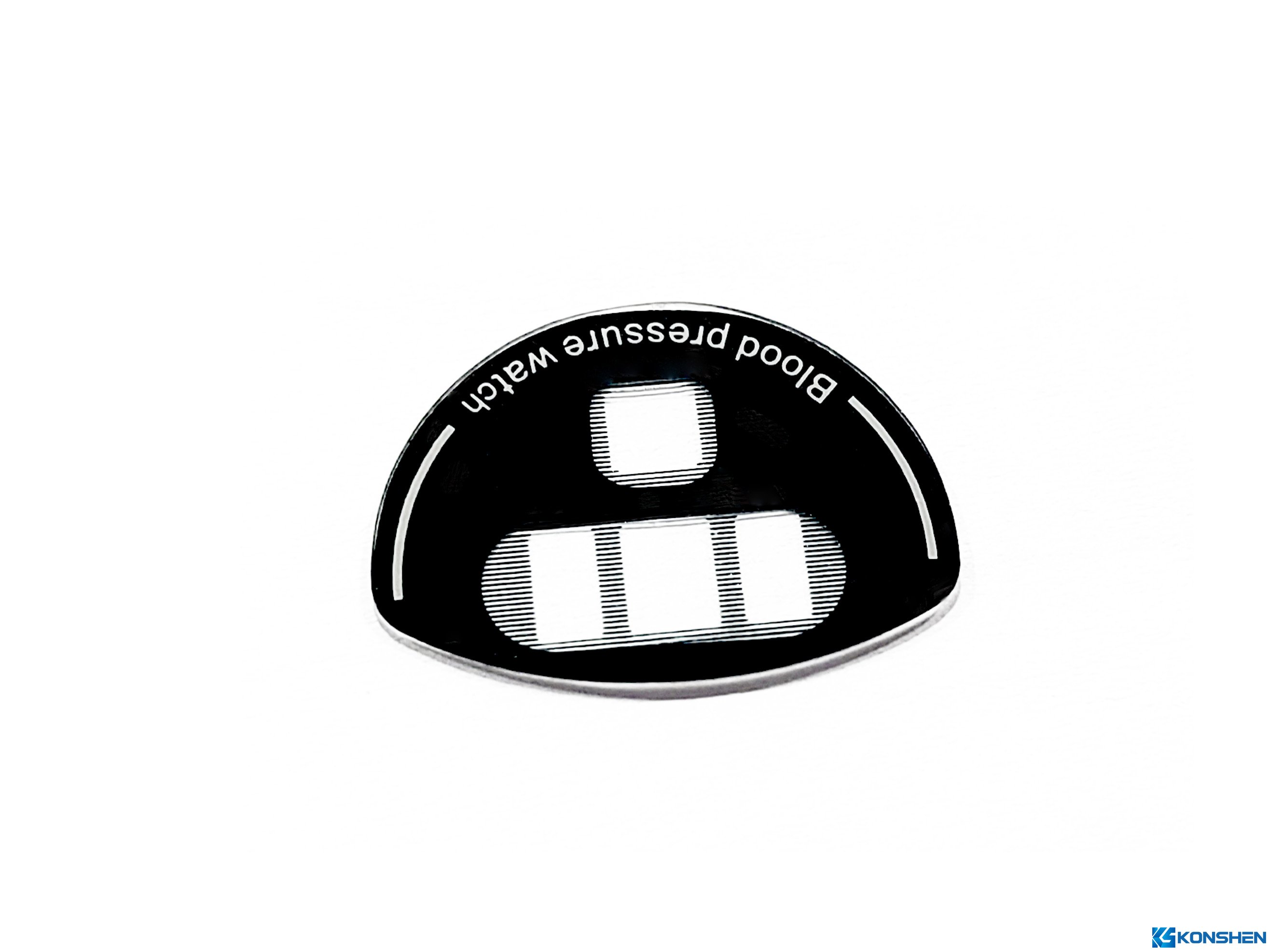
Conventional CNC or waterjet could not meet the required precision and edge consistency, especially at 0.5 mm thickness. Ultra-short pulse laser cutting achieved ±0.05 mm tolerance, controlling energy density and scanning path to minimize microcracks and ensure chemical strengthening effectiveness.
Small, intricate printing windows demanded precise registration and consistent ink layer thickness. KS Glass used custom high-precision screens and dedicated fixtures, controlling errors within ±0.05 mm. Ink viscosity, squeegee angle, and rebound speed were strictly managed to ensure sharp edges.
Project C: Gaming Simulator Cover
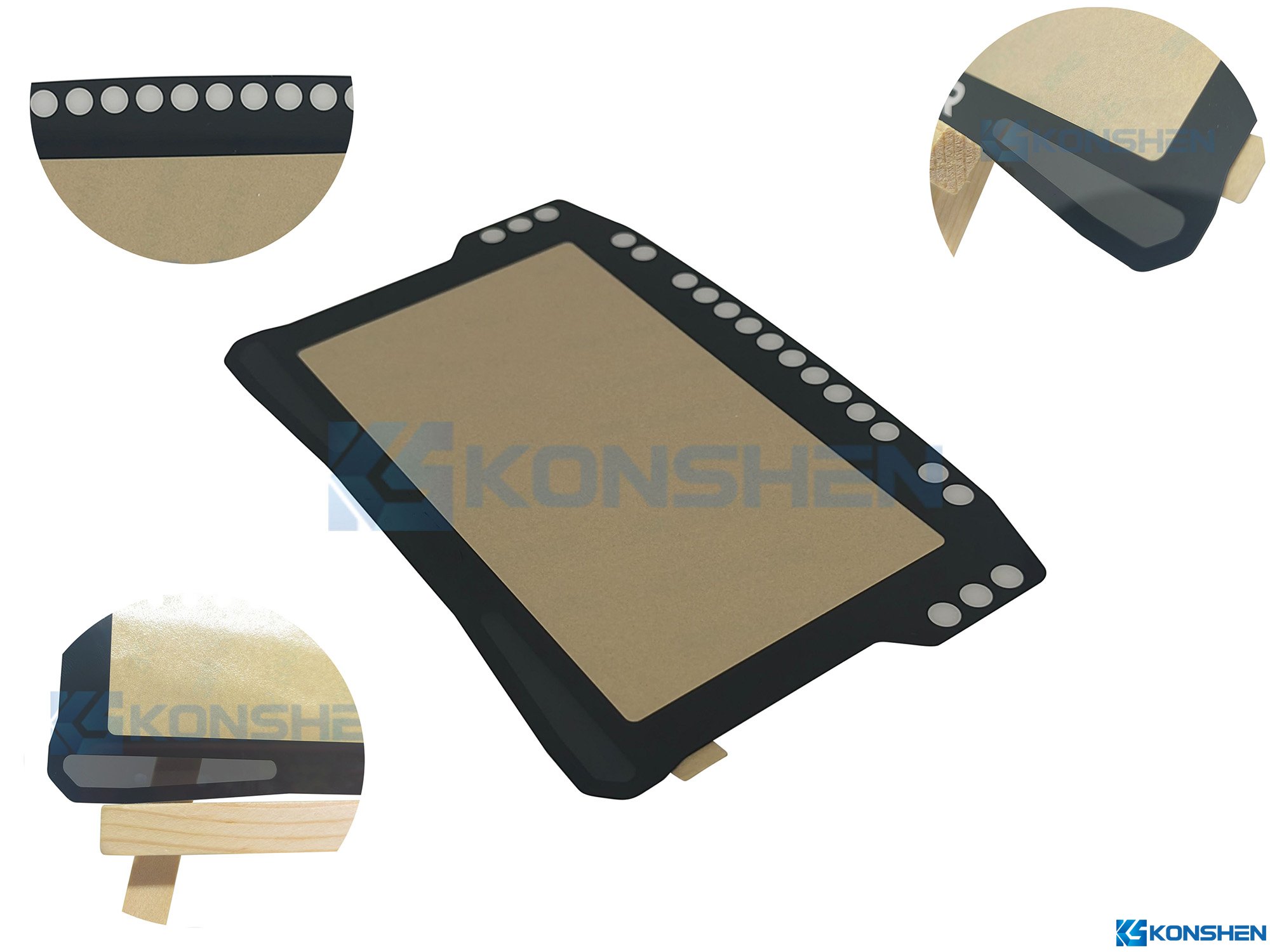
Overview: A mid-size, high-strength glass cover for a professional racing simulator required excellent aesthetics, high impact resistance, wear resistance, and precise fit with the device. It used 0.33 mm ultra-thin tempered glass with non-standard shapes, including frosted white, black, and semi-transparent black printing zones. AF coating, adhesive backing, and protective films were applied, ensuring cleanliness and no visible defects.
 Challenge 1: Edge Shaping and High-Precision Processing
Thin 0.33 mm glass with complex contours made edge grinding prone to chipping or cracking. CNC parameters were carefully adjusted by a senior technician to optimize yield.
Challenge 2: Printing Area Quality
Complex shapes increased difficulty in screen printing. High-precision custom screens and strict ink viscosity control ensured black, white, and semi-transparent zones met functional and aesthetic requirements. Semi-transparent black areas were eventually processed using a film lamination technique to resolve early-stage printing defects.
Challenge 3: High Appearance Quality
Customers required defect-free surfaces under visible inspection. All processing occurred in a cleanroom, with personnel wearing anti-dust garments, and 100% visual inspection under UV light before final delivery.
The final quality of special-shaped glass often begins with the cutting process. Selection of cutting methods, tool configuration, precision control, and problem-solving during cutting directly impact the yield of subsequent processes such as edge grinding, tempering, screen printing, and coating. Over nearly 20 years of glass production, KS Glass has accumulated extensive experience with cutting glass of various shapes, thicknesses, and materials. In this chapter, we systematically introduce mainstream cutting methods, commonly used tools, typical challenges, and practical solutions.
The cutting of special-shaped glass requires precise control of stress, heat, and mechanical forces to prevent microcracks, chipping, or distortion. Different shapes and thicknesses necessitate distinct cutting strategies to ensure both dimensional accuracy and surface integrity.
|
Cutting Method |
Processing Principle |
Applicable Scope |
Advantages |
Disadvantages |
|
Laser Cutting |
Uses a laser to locally heat the glass, creating a thermal stress difference. The glass naturally fractures along the path through controlled cooling airflow. |
Ultra-thin glass (0.2–1 mm), complex curves, special-shaped contours; applications include smartwatches, sensors, camera lenses, and small medical cover glass. Suitable for high-volume production. |
Smooth cut edges with minimal chipping; high precision up to ±0.01 mm. Non-contact process, no mechanical stress; complex structures can be formed in a single step. |
Only suitable for transparent glass. Slower cutting speed for thick glass. |
|
CNC Cutting |
Material removal via grinding: diamond tools gradually grind the glass layer by layer to achieve the desired shape. |
Glass thickness 2–10 mm; curved edges, stepped edges, deep special shapes; large-sized glass cover panels; products requiring high edge strength. |
Extremely high forming precision (±0.03–0.05 mm). High edge strength, resistant to chipping after tempering. Can simultaneously process chamfers, R-angles, grooves, and other structures. |
Slow processing speed. Higher cost. Generates grinding dust; requires sufficient cooling water. |
|
Waterjet Cutting |
High-speed waterjet mixed with abrasives cuts glass by erosion. |
Glass thicker than 5 mm; large structural components; special materials (e.g., low thermal expansion glass, ceramic glass). |
Can cut high-hardness or special materials. Low cutting stress. Strong material adaptability. |
Low precision (±0.2–0.5 mm). Rough cut edges. Slow cutting speed. Waterjet-produced glass debris may scratch the surface. |
Laser cutting machines consist of a laser source, galvanometer, focusing system, motion platform, cooling system, and control software. They are currently the most widely used equipment for special-shaped glass cutting.
Laser types: Common types include picosecond, femtosecond, and CO₂ lasers. Picosecond/femtosecond lasers are high-end solutions for ultra-thin glass due to their minimal heat-affected zones.
Advantages: Achieves micron-level kerf width, natural R-angle transitions, and low edge chipping; especially suitable for 0.3–1 mm ultra-thin glass and complex shapes.
Applications: Curved edges, small-sized special shapes, internal holes, slots, and other fine structures.
CNC machining centers consist of a spindle, tool system, clamps and fixtures, automatic tool changers (ATC), water-cooling system, and robotic platform. They are essential for precision glass processing.
Structural features: High-speed spindles paired with resin wheels or diamond bits allow chamfering, slotting, and stepped-edge processing.
Motion platform: High repeatability ensures consistent dimensions.
Advantages: Suitable for thicker glass (2–8 mm), 3D contours, and precise chamfering.
Typical applications: Chamfering all edges of gaming simulator cover glass, high-precision edge shaping.
Waterjet systems consist of a high-pressure pump, nozzle system, abrasive delivery, and gantry platform, cutting glass by high-speed water mixed with abrasives.
Advantages: Minimal cutting stress, no heat-affected zone; ideal for 5–15 mm thick large ultra-clear or float glass.
Limitations: Slower cutting speed and lower precision than laser or CNC; not suitable for small or ultra-thin glass.
Common applications: Pre-cutting large industrial panels or thick glass with special shapes.
2.3 Typical Cutting Challenges
Unlike standard rectangular glass, special-shaped glass often features complex curves, small R-angles, dense holes, ultra-thin thickness, narrow frames, and irregular contours, which pose multiple quality risks during processing. Based on KS Glass's experience in numerous projects, typical challenges and solutions include:
Causes:
Low strength of 0.2–0.8 mm ultra-thin glass, highly sensitive to mechanical stress
Stress concentration at cutting path corners
Excessive laser heat-affected zone or unstable energy parameters
Uneven force during glass separation
Solutions:
KS Glass uses non-contact laser cutting for ultra-thin glass to minimize thermal stress and microcrack risk. Cutting paths prioritize inner holes before outer contours to reduce stress concentration. Low-stress automatic separation systems prevent additional stress during glass detachment. Post-cutting, each piece undergoes polarizing stress inspection, with critical projects receiving additional edge processing and chemical strengthening to enhance edge strength and stability.
Causes:
Speed variations at curves or corners
Improper tool paths causing step marks or dimensional deviations
Small R-angles (e.g., R0.2–R0.3) requiring extremely high repeatability
Solutions:
High-precision laser equipment ensures smooth cutting paths. Algorithms maintain constant speed along curves to reduce corner jitter. Multiple sample comparisons are conducted before and after processing to correct tool path deviations. For products requiring high-quality curvature, CNC finishing after laser cutting ensures natural R-angle transitions and meets stringent precision standards.
Causes:
Heat accumulation in multiple structural areas
Stress concentration around dense holes
Improper cutting sequence causing dimensional drift
Solutions:
KS Glass applies a “cut inner before outer, small before large” strategy for multi-hole or complex-curve glass to reduce thermal accumulation. Cutting sequences are designed according to stress distribution to prevent secondary breakage. Inner holes are often cut with lasers, while outer contours are refined with CNC, improving dimensional stability and edge accuracy.
Causes:
Thermal drift of laser heads or CNC after long operation
Slight size changes due to glass thermal expansion
nadequate clamp and fixture positioning precision
Solutions:
KS Glass performs strict automatic calibration and regular checks on all laser and CNC machines to ensure optimal condition before processing. Critical areas are maintained in temperature-controlled environments to minimize dimensional changes. All fixtures are inspected and calibrated, with post-processing verification using 2.5D vision measuring systems to ensure final dimensions remain within target tolerances.
Causes:
Secondary cracks during handling or cleaning
Stress introduced by laser energy accumulation
Solutions:
KS Glass performs polarizing stress inspections on all special-shaped glass to detect invisible microcracks. Ultrasonic cleaning avoids secondary damage from high-pressure impact. For high-reliability applications like medical and wearable devices, 100% inspection and batch traceability ensure consistent and stable final products.
Common Challenges:
Numerous curves and small R-angles make it difficult for grinding wheels to precisely follow the contour.
Long edges or sharp corners are prone to chipping or notching.
Non-standard shapes complicate fixture stability and increase vibration.
Uneven glass thickness or large dimensions can cause localized stress concentration.
Solutions:
For complex edge structures of shaped glass, KS Glass selects diamond wheels according to different curvature radii for segmented processing. Sharp R-angles and corners prone to chipping are processed in a three-step sequence: rough grinding → semi-fine grinding → fine grinding, gradually removing stress while controlling feed rates to reduce vibration. For non-standard shapes, customized fixtures are used to improve stability. For large panels or thick glass, backing pads and damping layers are added to distribute local stress and improve edge consistency and flatness.
Common Challenges:
Irregular holes and complex contours cause uneven stress distribution.
Inner corners and sharp angles are prone to spontaneous breakage during tempering.
Large dimensions or uneven thickness lead to poor flatness after tempering.
Precision holes may shift after tempering.
Inconsistent cooling can result in unstable performance.
Solutions:
The core of shaped glass tempering is stress control. Before tempering, KS Glass performs CNC pre-processing to remove sharp stress points around holes and ensures that hole-to-edge ratios are within safe limits to prevent post-tempering breakage. During tempering, differential heating zones and airflow control are applied to achieve uniform strengthening across complex areas. For large-shaped components, auxiliary supports and tension algorithms predict deformation, allowing compensation through tooling and programming, ensuring consistent flatness and hole-position accuracy.
Common Challenges:
Irregular shapes make positioning difficult, resulting in significant alignment deviations.
Curved or irregular edges often cause incomplete ink coverage.
Large colored areas on complex shapes may show uneven brightness.
Multi-color printing requires high overlay accuracy and consistent curing.
Special processes such as semi-translucent black are more challenging.
Solutions:
To ensure consistent screen printing on shaped glass, KS Glass employs high-precision visual positioning systems to automatically recognize glass contours and key reference points, ensuring accurate alignment during printing. For curved or irregular areas, adjustments are made to mesh spacing, ink replenishment, and anti-bleeding design to maintain full ink coverage. Large-area prints are executed using segmented squeegeeing with constant pressure to ensure uniformity. Multi-color processes are carefully cured to prevent color shifts, achieving sharp, saturated, and durable prints.
Common Challenges:
Irregular edges may cause uneven coating distribution.
Deep holes or openings can create coating “shadow zones.”
High-curvature or polygonal shapes reduce target material utilization.
Variations in thickness can lead to inconsistent coating hardness or light transmittance.
Solutions:
During coating of shaped glass, KS Glass adjusts the rotation tray trajectory and target angles based on the product shape and coating requirements to improve layer uniformity. For deep holes or complex edges, bi-directional rotation is applied to ensure adequate coating coverage. To maintain optical performance, hardness, and adhesion of functional coatings, strict surface cleaning minimizes particle contamination. Finally, precise thickness monitoring ensures that each piece of shaped glass meets consistent optical and surface performance standards.
After processing, shaped glass must undergo a systematic inspection process to ensure dimensional accuracy, surface quality, and functional reliability meet customer requirements. Over nearly 20 years of experience, KS Glass has developed a comprehensive inspection system covering key parameters including dimensions, surface, edges, and functional performance.
Purpose:
Ensure that the dimensions, hole positions, and curve profiles of cut, ground, and tempered shaped glass conform to the design drawings.
Inspection Methods and Tools:
Vision Measuring Machine (VMM): Precisely measures curve contours, hole positions, R-angles, and edge deviations with an accuracy of ±0.01 mm.
Templates / Gauges:Quickly check the shape or hole spacing of small batches of shaped glass, suitable for in-line sampling on the production line.
Purpose:
Detect edge chipping, surface scratches, grinding marks, micro-cracks, and defects after grinding, tempering, printing, or coating.
Inspection Methods and Tools:
Polarized Stress Tester: Identifies invisible cracks and stress concentration, especially important for tempered and ultra-thin glass.
Microscope / Magnifier: Examines edge burrs, printing defects, and coating imperfections, suitable for inspecting fine details.
Purpose:
Ensure the uniformity, color accuracy, adhesion, and optical performance of screen prints and functional coatings such as AF, AR, or AG layers.
Inspection Methods and Tools:
Film Thickness Gauge: Controls the thickness of AF/AR/AG coatings, ensuring layer uniformity.
Spectrophotometer: Measures light transmittance, reflectance, and optical properties of functional coatings.
Adhesion Test Tools (Cross-cut Tester / Tape Test): Evaluate the adhesion strength of screen prints or coatings.
To ensure shaped glass meets stringent customer requirements in dimensional accuracy, surface quality, functional performance, and reliability, KS Glass has established a comprehensive quality control system covering raw materials, production processes, final inspection, and reliability testing. The system is divided into four stages: IQC → IPQC → OQC → Reliability Testing.
Purpose:
Ensure raw materials (e.g., ultra-clear glass, aluminosilicate glass, borosilicate glass) comply with design specifications and performance standards, providing a reliable foundation for subsequent processing.
Key Tasks:
Dimensional Inspection: Glass thickness, flatness, length/width deviations.
Material Performance Testing: Light transmittance, hardness, stress condition.
Surface Quality Check: Scratches, bubbles, inclusions, and other visible defects.
Batch Traceability: Establish tracking records for each batch to ensure material origin is controlled.
KS Glass Practical Experience:
For shaped glass production, 100% inspection of each raw material batch is performed, especially for ultra-thin or large-sized glass, to minimize downstream processing risks caused by material defects.
Purpose:
Monitor critical processing steps such as cutting, edge grinding, and tempering in real time, ensuring each stage meets process standards and reduces defect rates.
Key Tasks:
Cutting Stage: Monitor laser/CNC cutting paths, energy parameters, and edge quality.
Edge Grinding Stage: Inspect the smoothness and flatness of R-angles, chamfers, and stepped edges.
Tempering Stage: Monitor temperature curves, stress distribution, and edge safety.
Critical Process Sampling or 100% Full Inspection: Immediately adjust upon detecting anomalies.
KS Glass Practical Experience:
Process monitoring is combined with high-precision vision systems and polarized stress testers to ensure each shaped glass piece remains under control during processing, minimizing rework and scrap rates.
Purpose:
Ensure finished shaped glass fully complies with customer requirements and design specifications.
Key Tasks:
Dimension and Contour Inspection: Full-size verification using vision measuring machines and CMM.
Surface and Edge Inspection: Microscopes, surface roughness testers, and polarized stress testers.
Functional Performance Testing: Screen print positioning, color, coating thickness, and light transmittance.
Pre-Packaging Sampling: Ensure products are undamaged during transport.
KS Glass Practical Experience:
OQC involves full-size or high-percentage sampling, especially for multi-color screen printing, coated, or ultra-thin glass, ensuring every batch meets industrial-grade standards before delivery.
Purpose:
Verify the durability and stability of shaped glass under real-world application conditions.
Simulates impact during transportation or daily use to assess glass fracture resistance and edge strength.
Method: Use standard drop testers, considering product weight and dimensions, performing multi-angle, multi-height drops. For ultra-thin or small-shaped glass, use multi-face fixtures to simulate actual packaging drops.
Verify adhesion and corrosion resistance of functional coatings (AF/AR/AG) and screen printing under acidic, alkaline, or salt spray conditions.
Method: Salt spray testing from several hours to hundreds of hours, per customer requirements. Chemical corrosion tests use acids, bases, or organic solvents applied to the glass surface to check coating or print changes.
Assess stress and strength stability under temperature variations.
Method: Rapidly transfer glass between low (-20℃) and high (80–100℃) temperature environments or perform reverse cycles. Inspect for cracks, warping, or coating damage.
Evaluate the glass's ability to resist scratches and abrasion, especially for screens or touch panels.
Method: Use standard abrasion testers (Taber Abraser) for rotational wear, recording surface wear levels. Conduct pencil hardness tests on AF/AR/AG coatings to evaluate scratch resistance.
KS Glass Practical Experience: Reliability testing serves as the final quality gate for shaped glass. Coupled with batch tracking and data recording, it provides customers with traceable quality assurance, especially for high-end consumer electronics, industrial control, and medical device applications.
In the production of shaped glass, costs are influenced by multiple factors. Understanding these cost drivers helps in procurement, R&D, and production decisions to achieve reasonable budgeting and process optimization. The main factors are analyzed below:
The type of glass material directly affects base costs:
Ultra-clear Soda-lime Glass: High optical transmittance and low color deviation; suitable for high-end displays and precision instruments; relatively low material cost.
Aluminosilicate Glass (Mid/High Aluminum): High hardness and impact resistance; suitable for industrial and consumer electronics; price is between ultra-clear and borosilicate glass.
Borosilicate Glass: Excellent heat resistance and chemical stability; suitable for laboratory, medical, and specialized industrial applications; high material cost and processing difficulty.
Impact: Material cost not only depends on raw material price but also affects processing difficulty, yield, and subsequent coating/screen printing adhesion, indirectly increasing production cost.
The complexity of the glass shape is a key cost driver:
Number of Holes: More holes require longer processing time and higher mold/fixture costs.
Curve Ratio and Radius (R-angle): Smaller radii and more curves require higher precision, accelerating tool wear.
Non-standard Contours and Stepped Edges: Increase processing steps and setup time.
More complex shapes require additional CNC/laser cutting time and manual adjustments, directly raising processing costs and increasing scrap risk.
Single-color printing has a low cost. Multi-color or gradient printing requires additional screens, repeated alignment, and curing steps.
Each added color increases production complexity, labor cost, and yield requirements.
KS Glass Experience:Multi-color printing uses high-precision vision alignment and segmented squeegee techniques to ensure accurate and high-quality patterns, despite slightly higher costs.
Laser Cutting: Suitable for small, high-precision, or complex curved shaped glass; minimal tool wear but high equipment investment, resulting in higher per-piece cost.
CNC Cutting: Suitable for large or regular-shaped glass; high production efficiency, but complex curves or small R-angles may require additional processing or rework, indirectly increasing cost.
KS Glass Experience:
Choosing the optimal cutting method based on size, thickness, and complexity ensures precision while controlling processing cost.
Shaped glass may experience cracks, chipping, or coating defects during cutting, edge grinding, tempering, screen printing, or coating. Lower yield directly increases unit cost.Yield is affected by material type, thickness, shape complexity, processing experience, and process control level. KS Glass Experience: By implementing strict IQC/IPQC/OQC quality control systems and optimizing processing parameters, yield is maintained at a high level, effectively controlling cost.
Selecting the right supplier in shaped glass production not only affects product quality but also project delivery efficiency, cost control, and technical support. KS Glass, with nearly 20 years of glass manufacturing experience, provides high-quality, customizable, and reliable shaped glass solutions for B2B clients.
Extensive Shaped Glass Experience
The KS Glass team has participated in hundreds of shaped glass projects over the past two decades, covering consumer electronics, medical devices, industrial controls, and wearable applications. We have accumulated extensive experience in cutting, edge grinding, tempering, screen printing, and coating, handling glass from ultra-thin to thick panels and from simple curves to complex shapes. We respond rapidly to diverse project requirements, ensuring high precision, high yield production, and minimizing rework and development risks.
Comprehensive Quality Control System
We have established a four-level quality system: IQC → IPQC → OQC → Reliability Testing, ensuring end-to-end quality management from raw materials to finished products. Using high-precision equipment such as vision measuring systems, we ensure dimensions, edges, surfaces, and functional performance meet industrial standards. This guarantees the reliability of shaped glass in demanding environments, providing traceable, industrial-grade quality assurance.
Flexible Customization Capability
KS Glass supports laser cutting, CNC cutting, and water jet cutting. Processing methods are selected based on thickness, size, and curve complexity. We offer physical tempering, chemical strengthening, multi-color screen printing, UV printing, functional coatings (AF/AR/AG), and special edge treatments (R-angle, chamfer, stepped edges), meeting stringent precision and process requirements.
Cost Optimization and High Yield Production
Through scientific process design, workflow optimization, and strict quality control, we achieve high yield, reduce scrap, and minimize processing loss. Based on material type, thickness, shape complexity, and multi-color printing, we provide customers with cost control recommendations. Production plans are flexibly optimized to meet different order volumes while maintaining quality.
Professional Technical Support
We provide full-process technical support from design evaluation, sample prototyping, process optimization, to mass production. KS Glass offers drawing reviews, process guidance, material selection, and reliability testing reports, ensuring projects are delivered smoothly with high responsiveness to customer feedback.
Shaped glass is widely applied in modern electronics, medical devices, and industrial equipment, offering value through high-precision design, custom processing, and reliable performance. Through scientific processes, strict quality systems, and an experienced technical team, KS Glass delivers high-quality, cost-controlled shaped glass solutions, helping customers bring reliable products to market efficiently.
Ready to take your glass project to the next level? Contact us today to discuss your custom glass needs and get a quote!
contact us